

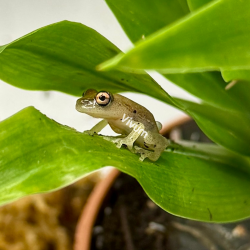

| Common Name: | Reed Frog de Madagáscar |
| Scientific Name: | Heterixalus alboguttatus |
| CITES Appendix: | No |
| Annex II Portuguese Ordinance No. 86/2018: | No |
Under Portuguese Law No. 95/2017 of 23 August, the sale and/or advertising of wild/exotic animals through websites or online platforms is not permitted. To find out which animals we currently have available and their conditions of sale, please get in touch with us.
 Progressive Discounts
The more you buy, the less you pay for transport
Progressive Discounts
The more you buy, the less you pay for transport
 Same Day Dispatch
For orders finalized by 3pm
Same Day Dispatch
For orders finalized by 3pm
 Live/Frozen Guaranteed Delivery
In live and frozen food
Live/Frozen Guaranteed Delivery
In live and frozen food
Size: Females up to 3.5 cm, males up to 2.5 cm
Origin: Madagascar
Lifespan: Up to 5 years in captivity
Natural Habitat: Riparian and wet areas such as pond margins, temporary marshes, rice paddies, ditches and moist savannah with emergent vegetation, at low to mid altitudes in Madagascar
The Reed frog de Madagáscar is a small semi-arboreal frog endemic to Madagascar, belonging to the group known as reed frogs. It is characterised by its dark colouring with contrasting pale spots, often described as a "starry" pattern. It is a predominantly nocturnal species that spends the day hidden on the underside of emergent vegetation and becomes active at dusk and during the night.
This species can slightly change colour in response to humidity, temperature and light. It is considered relatively easy to keep in captivity, provided the environmental conditions suited to its riparian lifestyle are met.
Although hardy, it is essential to ensure correct temperature, humidity, feeding and supplementation, as described below.
Size: A terrarium of at least 45 x 45 x 60 cm is recommended for a group of 2 to 4 adults
Material: Glass, with a mesh top for adequate ventilation
During the day, the ambient temperature should be between 21 °C and 24 °C, with a slight gradient in the upper part of the terrarium reaching 26–28 °C. At night, the temperature can safely drop to 18–20 °C.
Heating, when needed, should be gentle and localised, avoiding intense hot spots. A low-wattage heat lamp or other suitable system is recommended, always controlled by a quality thermostat.
Although mainly nocturnal, it benefits from exposure to low UVB levels (Ferguson Zone 1–2). Low-intensity UVB lamps (5–7%) can be used, placed about 25–30 cm from resting areas and replaced according to the manufacturer's recommendations.
Relative humidity should be kept between 70% and 80%, reflecting its natural habitat. Lower values can only be tolerated for short periods, provided there is permanent access to clean water.
Mist the terrarium once or twice a day, mainly on the vegetation and shelter areas.
A shallow container of clean, fresh, dechlorinated water should always be available. The frogs often use it to hydrate, so it should be changed daily.
As a semi-arboreal species associated with riparian environments, the terrarium should favour height and include plenty of vegetation. The substrate can be coco fibre, sphagnum moss or a suitable bioactive mix, at least 5 cm deep.
Include branches, logs, vertical stems and dense plants (live or artificial), such as pothos, ficus, bromeliads or emergent aquatic plants. These provide resting places and shelter and help keep humidity stable. It is important to provide spots where the frogs can rest on the underside of leaves.
A shallow water area about 3–5 cm deep is recommended to simulate the species' natural environment.
Feeding habits: Insectivorous
Diet: Adults should be fed 3 to 4 times a week with appropriately sized live insects. Juveniles need smaller prey and more frequent feeding.
Insects: Crickets (micro and small), fruit flies, small roaches, micro locusts and other insects suited to the animal's size.
Supplementation is essential for this species' health. All insects should be dusted with high-quality calcium and vitamin supplements before being offered.
Supplements should contain calcium, vitamin D3 and preformed vitamin A (retinol), as amphibians do not efficiently convert beta-carotene. Alternating between pure calcium and a complete multivitamin is recommended. Inadequate supplementation can quickly lead to metabolic bone disease.
Under Portuguese Law No. 95/2017 of 23 August, the sale and/or advertising of wild/exotic animals through websites or online platforms is not permitted. To find out which animals we currently have available and their conditions of sale, please get in touch with us.