
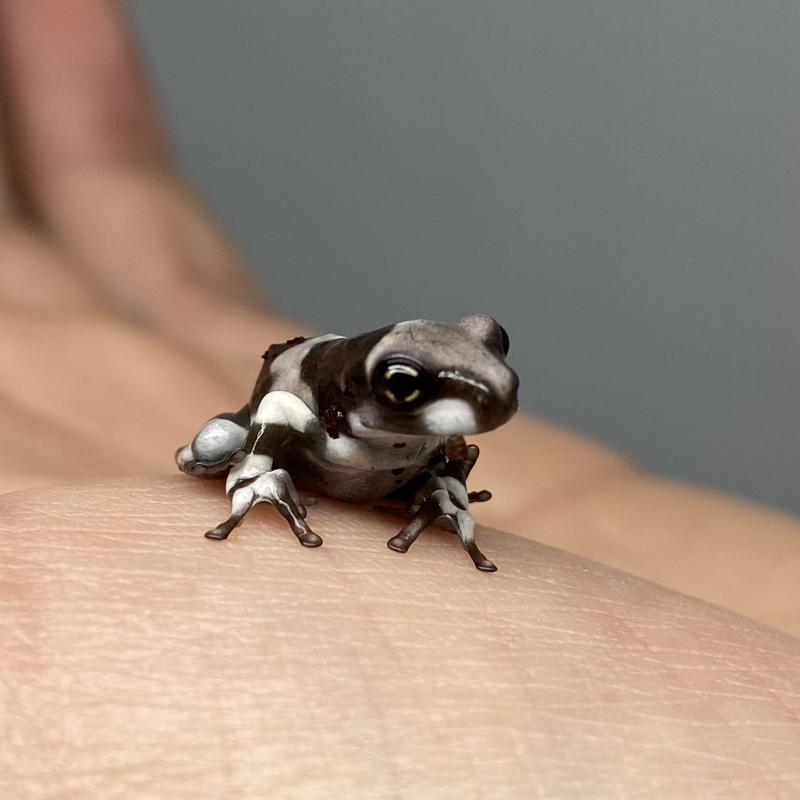
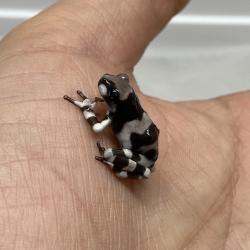
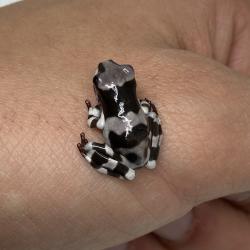
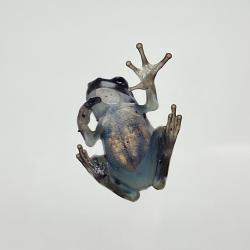
| Common Name: | Amazon Milk Frog |
| Scientific Name: | Trachycephalus resinifictrix |
| CITES Appendix: | No |
| Annex II Portuguese Ordinance No. 86/2018: | No |
Under Portuguese Law No. 95/2017 of 23 August, the sale and/or advertising of wild/exotic animals through websites or online platforms is not permitted. To find out which animals we currently have available and their conditions of sale, please get in touch with us.
 Progressive Discounts
The more you buy, the less you pay for transport
Progressive Discounts
The more you buy, the less you pay for transport
 Same Day Dispatch
For orders finalized by 3pm
Same Day Dispatch
For orders finalized by 3pm
 Live/Frozen Guaranteed Delivery
In live and frozen food
Live/Frozen Guaranteed Delivery
In live and frozen food
O conteúdo (Texto e Fotografias) desta página está protegido por direitos de autor. A sua cópia, redistribuição ou modificação sem autorização prévia poderá resultar em responsabilização legal.
Size: Adults can reach 10 cm
Origin: South America (Amazon basin)
Lifespan: Up to 10 years in captivity
Natural Habitat: They inhabit the tree canopy of humid rainforests of the Amazon basin (South America).
The Amazon Milk Frog is an easy-to-keep frog species, though sometimes hard to find. It has a voracious appetite, grows large and does very well in small groups in humid planted terrariums.
Although this is a relatively easy species to keep, you should pay attention to a few aspects and ensure certain conditions, which you will find in the following paragraphs.
Size: A 45x45x60cm terrarium is recommended for 2-4 adults
Material: Glass
During the day, a temperature between 24ºC and 26ºC should be maintained. At night, the temperature can drop to 22ºC. The easiest and most practical way to achieve these temperatures is with a Heat Mat placed externally on one side of the terrarium. Like any heat source, the Heat Mat should be properly regulated by a thermostat.
The Amazon Milk Frog does not need UVB. However, it benefits from exposure to low levels (using a ShadeDweller Arboreal lamp)
Water should always be available, either as a pool or pond where the frogs can soak or even covering the entire bottom of the terrarium. This species requires a relative humidity of at least 60%, ideally around 80%.
The Amazon Milk Frog feels comfortable among foliage and branches. Equip the terrarium with plenty of vertical structure so they can occupy the highest parts. You can use branches, cork bark, stones and plants (artificial or live). Young animals should not be kept in overly large terrariums, to make feeding easier.
Feeding habits: Insectivorous
Diet: They should be fed every night with a variety of live insects.
Insects: The staple diet should be Crickets, but it is useful to vary with Calcium Worms, Mealworms/Buffalo Worms and Waxworms...
For vitamin and mineral supplementation, dust 2 meals a week with Calcium Powder and one with a quality Multivitamin Complex (with Vit. D3).
Under Portuguese Law No. 95/2017 of 23 August, the sale and/or advertising of wild/exotic animals through websites or online platforms is not permitted. To find out which animals we currently have available and their conditions of sale, please get in touch with us.
