
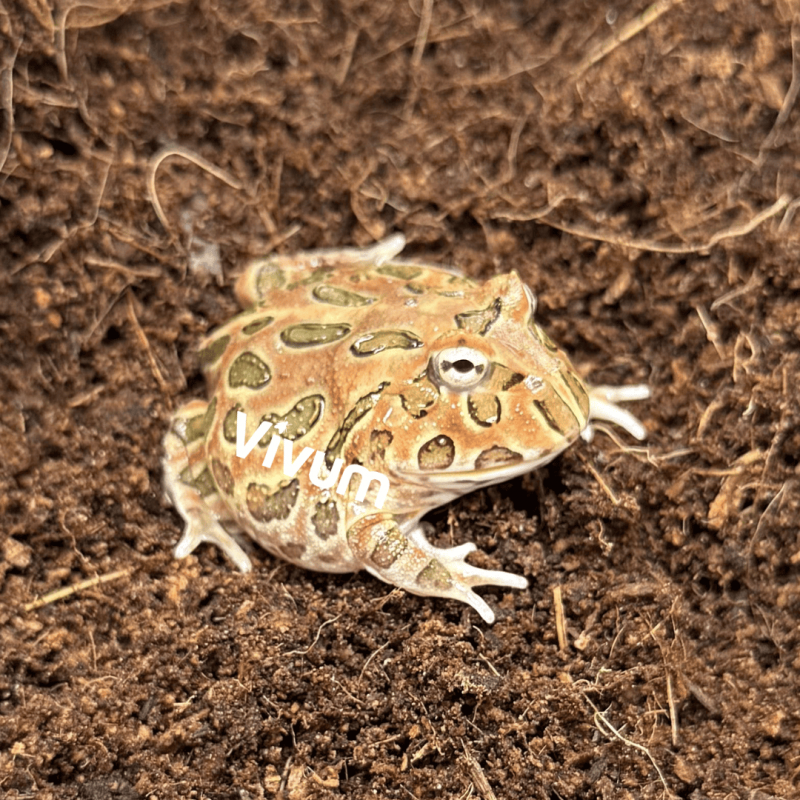

| Common Name: | Sapo Pacman |
| Scientific Name: | Ceratophrys cranwelli |
| CITES Appendix: | No |
| Annex II Portuguese Ordinance No. 86/2018: | No |
Under Portuguese Law No. 95/2017 of 23 August, the sale and/or advertising of wild/exotic animals through websites or online platforms is not permitted. To find out which animals we currently have available and their conditions of sale, please get in touch with us.
 Progressive Discounts
The more you buy, the less you pay for transport
 Same Day Dispatch
For orders finalized by 3pm
 Live/Frozen Guaranteed Delivery
In live and frozen food
O conteúdo (Texto e Fotografias) desta página está protegido por direitos de autor. A sua cópia, redistribuição ou modificação sem autorização prévia poderá resultar em responsabilização legal.
Size: As adults, females can reach 13cm and males 10cm
Origin: South America
Lifespan: Up to 10 years in captivity
Natural Habitat: They inhabit the forest floor of South American rainforests
The Sapo Pacman is one of the most distinctive frog species kept in captivity. Its round body, the range of colours available and its patterns make it very easy to identify. It is very easy to keep and has very few requirements, making it ideal for anyone wanting their first amphibian. It is a terrestrial, burrowing species that benefits from a small pool to soak in.
Although this is a relatively easy species to keep, you should pay attention to a few aspects and ensure certain conditions, which you will find in the following paragraphs.
Size: A 60x45x30cm terrarium is recommended for 1 adult
Material: Glass, acrylic or plastic
During the day, a temperature between 24ºC and 28ºC should be maintained. At night, the temperature can drop to 22ºC. The easiest and most practical way to achieve these temperatures is with a Heat Mat placed externally on one side or underneath of the terrarium. Like any heat source, the Heat Mat should be properly regulated by a thermostat.
The Pacman does not need UVB. However, it benefits from exposure to low levels (using a ShadeDweller lamp)
Water should always be available as a small pool/pond where the Pacmans can soak. This species requires a relative humidity of at least 60%, ideally around 80%.
The Sapo Pacman is a burrowing ambush predator. With this in mind, the terrarium should have a loose, non-abrasive substrate it can easily bury itself in. You can use branches, cork bark, stones and plants (artificial or live).
Feeding habits: Insectivorous
Diet: They should be fed every day.
Insects: The staple diet should be Crickets and Roaches. You can occasionally vary with Mealworms, Waxworms and Calcium Worms.
For vitamin and mineral supplementation, dust 2 meals a week with Calcium Powder and one with a quality Multivitamin Complex (with Vit. D3).
Under Portuguese Law No. 95/2017 of 23 August, the sale and/or advertising of wild/exotic animals through websites or online platforms is not permitted. To find out which animals we currently have available and their conditions of sale, please get in touch with us.

