
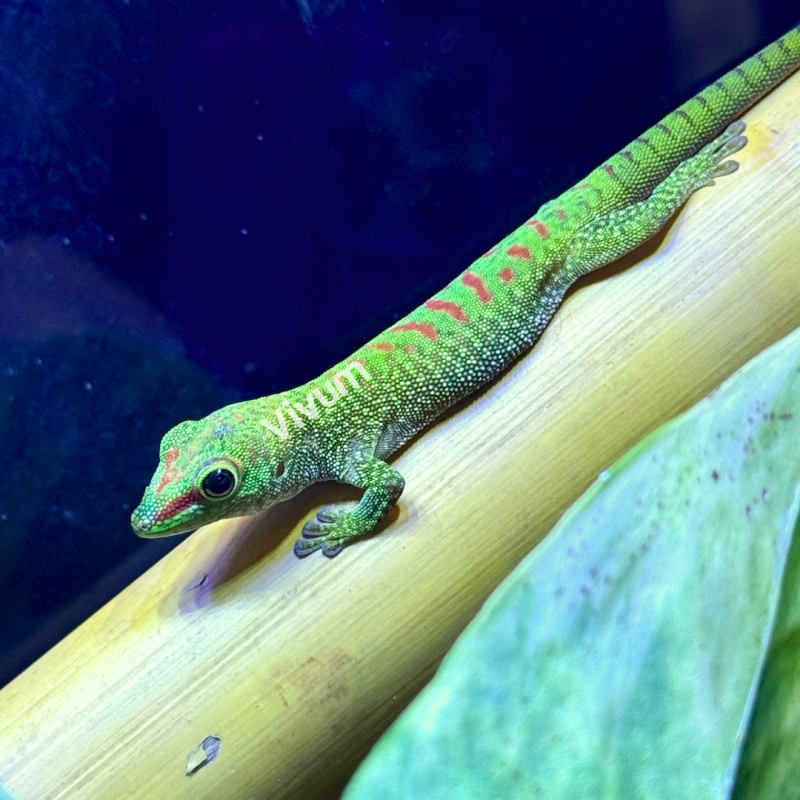
| Common Name: | Phelsuma madagascariensis grandis |
| Scientific Name: | Phelsuma madagascariensis grandis |
| CITES Appendix: | Yes, IIB |
| Annex II Portuguese Ordinance No. 86/2018: | No |
Under Portuguese Law No. 95/2017 of 23 August, the sale and/or advertising of wild/exotic animals through websites or online platforms is not permitted. To find out which animals we currently have available and their conditions of sale, please get in touch with us.
 Progressive Discounts
The more you buy, the less you pay for transport
Progressive Discounts
The more you buy, the less you pay for transport
 Same Day Dispatch
For orders finalized by 3pm
Same Day Dispatch
For orders finalized by 3pm
 Live/Frozen Guaranteed Delivery
In live and frozen food
Live/Frozen Guaranteed Delivery
In live and frozen food
Size: Adults can reach 25-30cm
Origin: Northern Madagascar
Lifespan: Up to 20 years
Natural Habitat: Tropical and subtropical forests of northern Madagascar
Phelsuma madagascariensis grandis, also known as the giant Madagascar day gecko, is the largest species in the Phelsuma genus. It is characterised by its dazzling bright green colouring with distinctive red markings running from the nose to the eyes and along the back. These diurnal, arboreal animals spend most of their time among tropical vegetation. Their striking beauty, daytime activity and impressive size make them a popular choice for reptile enthusiasts with some experience.
Although relatively hardy compared to other Phelsuma species, they require specific care, particularly regarding lighting, humidity and diet. Certain conditions, described in the following paragraphs, must be ensured to guarantee the health and wellbeing of these remarkable animals.
Size: A 60x45x90cm terrarium is recommended for 1 adult
Material: Glass (with mesh top for adequate ventilation)
A terrarium with a thermal gradient should be provided, with an ambient daytime temperature between 24ºC and 28ºC. The basking spot should reach 32-35ºC. At night the temperature can drop to 20ºC, but not lower. Heat lamps can be used during the day to maintain these temperatures.
UVB radiation is essential for this diurnal species. A UVI of 2.0 to 4.0 (Ferguson Zone 2) is recommended, achievable with 5 to 7% UVB tubes. Lighting should be on 12-14 hours a day in summer and 11-12 hours in winter. Full-spectrum LED lighting is also recommended to encourage more vivid colours and natural behaviour.
Phelsuma madagascariensis grandis needs relative humidity between 60% and 80%. Humidity should fluctuate through the day, being higher in the morning and evening. To achieve this, misting the terrarium 1-2 times a day is recommended. Automatic misting systems can be useful but are not essential if a consistent manual misting routine is kept.
A water bowl with clean, fresh water should always be available on a raised platform, although these geckos often prefer to drink droplets from leaves after misting.
As a strictly arboreal species, the terrarium should prioritise height over width. Furnish it with plenty of climbing options such as vertical cork logs, bamboo, branches and plants (artificial or live). Live plants such as bamboo, ficus, pothos, climbing philodendrons and peace lilies not only provide places to climb, hide and thermoregulate but also help maintain the high humidity required.
For substrate, coco fibre, a mix of coco fibre and fertiliser-free soil, or simply paper can be used. The substrate should be at least 5cm deep. It is important to create several resting areas at different heights so the animal can choose its preferred spot.
Feeding habits: Omnivorous
Diet: Phelsuma madagascariensis grandis feed on insects as well as nectar and fruit. In captivity, the diet should be a balanced combination of live insects and specific commercial day-gecko diets. Juveniles should be fed insects daily and commercial diet on alternate days. Adults should receive insects 2-3 times a week and commercial diet 1-2 times a week.
Commercial diets: Pangea, Repashy, Gecko Nutrition or other specific day gecko or crested gecko diets enriched with vitamins and minerals
Insects: Crickets, Roaches, Locusts, Black Soldier Fly Larvae, Waxworms (occasionally), Fruit Flies
Fruit (occasionally and puréed): Mango, Banana, Papaya, Peach
Regarding vitamin and mineral supplementation, specific commercial day-gecko diets already include a balanced mix of essential nutrients. However, all insects offered should be dusted with Calcium Powder before each feeding. In addition, once a week, insects should be supplemented with a good-quality Multivitamin Complex (with Vit. D3).
It is crucial to gut-load insects 24-48 hours before offering them to the gecko, using nutritious vegetables and commercial insect feed, to maximise their nutritional value.
Under Portuguese Law No. 95/2017 of 23 August, the sale and/or advertising of wild/exotic animals through websites or online platforms is not permitted. To find out which animals we currently have available and their conditions of sale, please get in touch with us.
