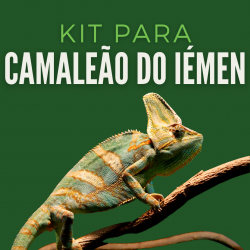
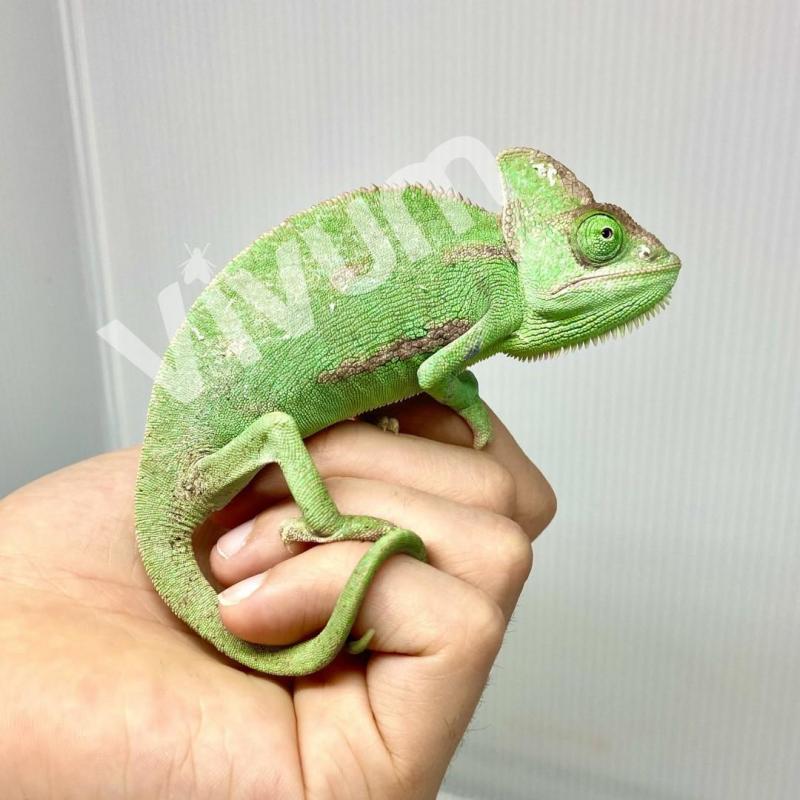
Generic photo of the species
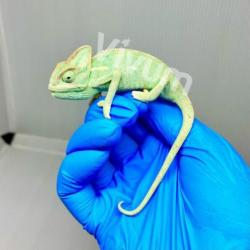
| Common Name: | Camaleão do Iémen |
| Scientific Name: | Chamaeleo calyptratus |
| CITES Appendix: | Yes, IIB |
| Annex II Portuguese Ordinance No. 86/2018: | No |
Under Portuguese Law No. 95/2017 of 23 August, the sale and/or advertising of wild/exotic animals through websites or online platforms is not permitted. To find out which animals we currently have available and their conditions of sale, please get in touch with us.
 Progressive Discounts
The more you buy, the less you pay for transport
 Same Day Dispatch
For orders finalized by 3pm
 Live/Frozen Guaranteed Delivery
In live and frozen food
O conteúdo (Texto e Fotografias) desta página está protegido por direitos de autor. A sua cópia, redistribuição ou modificação sem autorização prévia poderá resultar em responsabilização legal.
Size: Males can reach 45–60 cm including the tail; females are smaller, around 30–35 cm
Origin: Yemen and south-western Saudi Arabia
Lifespan: 6 to 8 years for males; females usually live less (4 to 6 years)
Natural Habitat: They inhabit the mountainous and wooded areas, from tropical to semi-arid, of Yemen and south-western Saudi Arabia
Other names: Veiled Chameleon, Yemen Chameleon
Like most chameleons, the Camaleão do Iémen is an arboreal species. It inhabits the wooded areas, from tropical to semi-arid, of the Arabian Peninsula. It is one of the most commonly kept chameleon species.
They are solitary and territorial animals: they must be housed individually and handling should be kept to a minimum, as they are easily stressed.
Although it is a species of intermediate difficulty, keeping it in captivity is perfectly achievable if a few basic care guidelines are followed, as described in the following paragraphs.
Size: At least 60x45x60 cm for 1 juvenile or female; 60x60x120 cm for 1 adult male
Material: Glass (with mesh top/good airflow) or Mesh
During the day, a temperature between 24 °C and 28 °C should be maintained, with a Basking Spot of around 35 °C. A Halogen Lamp is needed to create the basking area.
At night the temperature should drop to around 16–20 °C, with no light at all: this night-time drop is beneficial and, in most homes, no heating is needed. If the temperature falls below 16 °C, a Ceramic Heat Emitter or a Deep Heat Projector, which emit no light, can be used.
As for ultraviolet radiation, it is essential that during the day they are exposed to a UVI of 3 to 4 (Ferguson Zone 3). To reach these UV levels, 6% to 12% UV tubes can be used, depending on the height of the terrarium.
This species requires a relative humidity of at least 50%, ideally around 60%. Mist the terrarium at least twice a day (or use a drip system), as the Camaleão do Iémen rarely drinks from a bowl and prefers to drink the droplets left on leaves.
The Camaleão do Iémen feels comfortable among foliage. Furnish the terrarium with plenty of vertical structure so it can use the upper areas. Branches, cork bark, stones and plants can be used, preferably live plants that are safe if eaten. Young animals should not be kept in overly large terrariums.
Females lay eggs even without a male present. From 4–6 months of age, provide a laying container at least 30 cm deep, filled with a moist substrate (soil or a soil and sand mix) that holds its shape when dug. A female that digs persistently or stops eating may be ready to lay. If she cannot find a suitable site, there is a risk of egg binding, a serious condition that requires veterinary care.
Feeding habits: Insectivorous
Diet: Juveniles should be fed live insects every day; adults every other day. Overfeeding leads to obesity and, in females, excessive egg production. You will also see them eating the live plants in the terrarium.
Insects: Locusts, Crickets, Roaches, Calcium Worms...
Feeder insects should be well fed (gut-loaded) during the 24 to 48 hours before they are offered, to increase their nutritional value.
Juveniles: each week, dust the insects with Calcium (without D3) at 5 meals and with a good-quality Multivitamin Complex at 1 meal.
Adults: each week, dust the insects with Calcium (without D3) at 3 meals and with a good-quality Multivitamin Complex at 1 meal.
As they are exposed to UVB radiation, which allows them to produce their own vitamin D3, Calcium without D3 should be used. Chameleons are particularly sensitive to excess vitamin D3.
Under Portuguese Law No. 95/2017 of 23 August, the sale and/or advertising of wild/exotic animals through websites or online platforms is not permitted. To find out which animals we currently have available and their conditions of sale, please get in touch with us.