

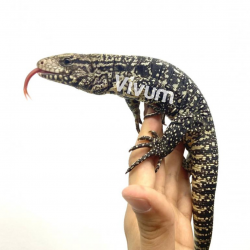


| Common Name: | Tegú Preto e Branco Argentino |
| Scientific Name: | Salvator merianae |
| CITES Appendix: | Yes, IIB |
| Annex II Portuguese Ordinance No. 86/2018: | No |
Under Portuguese Law No. 95/2017 of 23 August, the sale and/or advertising of wild/exotic animals through websites or online platforms is not permitted. To find out which animals we currently have available and their conditions of sale, please get in touch with us.
 Progressive Discounts
The more you buy, the less you pay for transport
 Same Day Dispatch
For orders finalized by 3pm
 Live/Frozen Guaranteed Delivery
In live and frozen food
O conteúdo (Texto e Fotografias) desta página está protegido por direitos de autor. A sua cópia, redistribuição ou modificação sem autorização prévia poderá resultar em responsabilização legal.
Size: Adults can reach up to 1.5 metres in length.
Origin: Argentina, Paraguay and Brazil.
Lifespan: They can live 15 to 20 years in captivity.
Natural Habitat: Tropical and subtropical areas, including forests, savannahs and wetlands.
Tegu Argentino are fascinating lizards, known for their impressive appearance, intelligence and complex, individual behaviour. Although they are challenging pets, with proper care they can be kept successfully in captivity.
Although this is a relatively easy species to keep, a few aspects require attention and certain conditions must be ensured, as described in the following paragraphs.
Size: Minimum of 200x100x100cm for 1 adult
Material: Glass or Wood
Tegu Argentino need a thermal gradient in the terrarium so they can regulate their body temperature. The basking area should reach approximately 37-38°C, while the cooler area should be around 24-27°C. At night the temperature can drop to 21-24°C.
High-quality UVB lighting must be provided to allow vitamin D3 synthesis. Use lamps with a high UV index, such as T5 14% tubes or mercury vapour/solar lamps.
Keep relative humidity at around 60-70%. This can be achieved by misting the terrarium twice a day. A humid hide with moss or moist substrate can also be provided to help with thermoregulation and hydration.
Provide a variety of hides, logs, branches and rocks in the terrarium so the Tegu Argentino can explore and feel secure. It is important to create some vertical structure so they can climb and exercise.
Choose a safe, easy-to-clean substrate such as coco substrate. Avoid substrates that could be accidentally ingested, such as sand or wood chips.
Feeding habits: Omnivorous
The Tegu Argentino's diet should consist of a variety of animal and plant proteins. Include foods such as insects (crickets, mealworms, earthworms...), eggs, raw meat (chicken, fish) and a variety of fruit and vegetables. Make sure to offer a balanced, varied diet to ensure proper nutrition.
For vitamin and mineral supplementation, alternate a meal dusted with Calcium Powder with one dusted with a good-quality Multivitamin Complex (with Vit. D3).
Under Portuguese Law No. 95/2017 of 23 August, the sale and/or advertising of wild/exotic animals through websites or online platforms is not permitted. To find out which animals we currently have available and their conditions of sale, please get in touch with us.
