
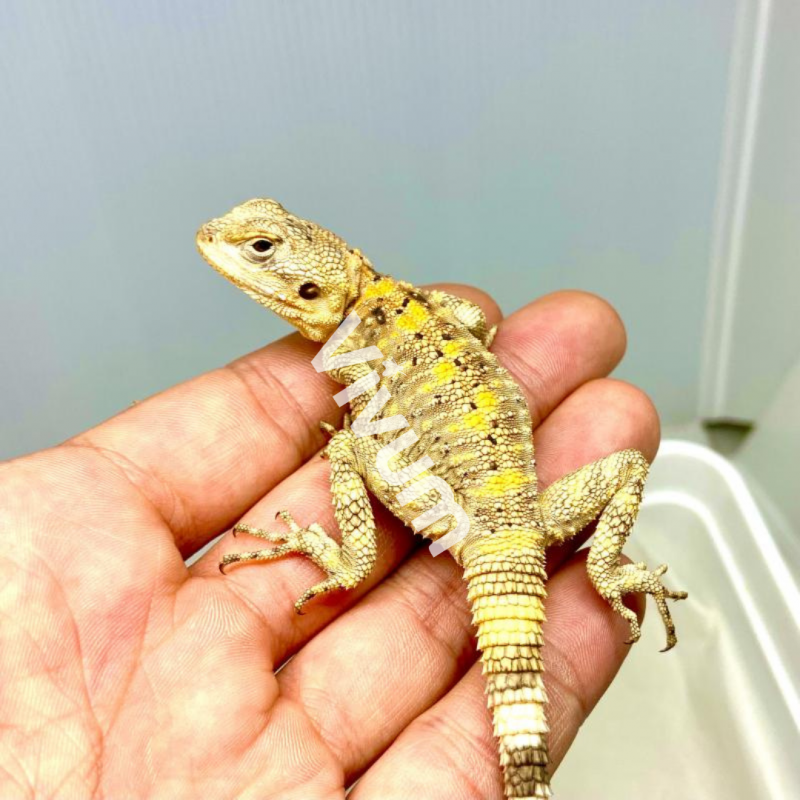

| Common Name: | Dragão Pintado |
| Scientific Name: | Laudakia stellio brachydactyla |
| CITES Appendix: | No |
| Annex II Portuguese Ordinance No. 86/2018: | No |
Under Portuguese Law No. 95/2017 of 23 August, the sale and/or advertising of wild/exotic animals through websites or online platforms is not permitted. To find out which animals we currently have available and their conditions of sale, please get in touch with us.
 Progressive Discounts
The more you buy, the less you pay for transport
 Same Day Dispatch
For orders finalized by 3pm
 Live/Frozen Guaranteed Delivery
In live and frozen food
O conteúdo (Texto e Fotografias) desta página está protegido por direitos de autor. A sua cópia, redistribuição ou modificação sem autorização prévia poderá resultar em responsabilização legal.
Size: Adults can reach 30cm
Origin: North Africa and the Middle East
Lifespan: Up to 15 years in captivity
Natural Habitat: Hot, arid deserts of North Africa and the Middle East
The Dragão Pintado is a desert lizard species of growing popularity. Its similarity to the Dragão Barbudo (in both appearance and care), combined with its smaller size, makes it an excellent choice as a pet.
Although this is a relatively easy species to keep, a few aspects require attention and certain conditions must be ensured, as described in the following paragraphs.
Size: Minimum of 90x45x45cm for 2 adults
Material: Glass or Wood
A terrarium with a thermal gradient should be provided, with a minimum temperature of 22ºC on the cool side, around 30ºC on the warm side and above 35ºC directly beneath the heat lamp/basking spot. At night, a Ceramic Heat Emitter or a Deep Heat Projector can be used to ensure the temperature does not drop below 20ºC.
Regarding ultraviolet radiation, it is essential that during the day they are exposed to a UVI between 3 and 7 (Ferguson Zone 3-4). To achieve these UV Index levels, 12 to 14% tubular UV lamps can be used.
Coming from desert regions, these lizards are used to low relative humidity. The terrarium can be misted occasionally, creating temporary humidity peaks that some individuals use to hydrate.
It is essential to always have a water bowl with clean water available in the terrarium so the lizard can stay hydrated.
It is important to use either a substrate without loose particles (Reptile Carpets / Sand Mats) or digestible substrates that are safe for reptiles (Arcadia Earth Mix Arid). A three-dimensional habitat can be created using branches and rocks, making sure they are well secured. Especially with young animals, it is advisable to provide a few hiding places to avoid unnecessary stress.
Feeding habits: Omnivorous
Juvenile Diet: 25% Plants and 75% Insects
Adult Diet (From 2 years): 75% Plants and 25% Insects*
*Make a gradual transition between the juvenile and adult diet.
Insects: Crickets, Roaches, Locusts, Mealworms, Waxworms, Calcium Worms...
Plants: Broccoli, Cabbage, Parsley, Watercress, Clover, Coriander, Radish, Bell Pepper, Green Beans, Dandelion...
For vitamin and mineral supplementation, alternate a meal dusted with Calcium Powder with one dusted with a good-quality Multivitamin Complex (with Vit. D3).
Under Portuguese Law No. 95/2017 of 23 August, the sale and/or advertising of wild/exotic animals through websites or online platforms is not permitted. To find out which animals we currently have available and their conditions of sale, please get in touch with us.
