
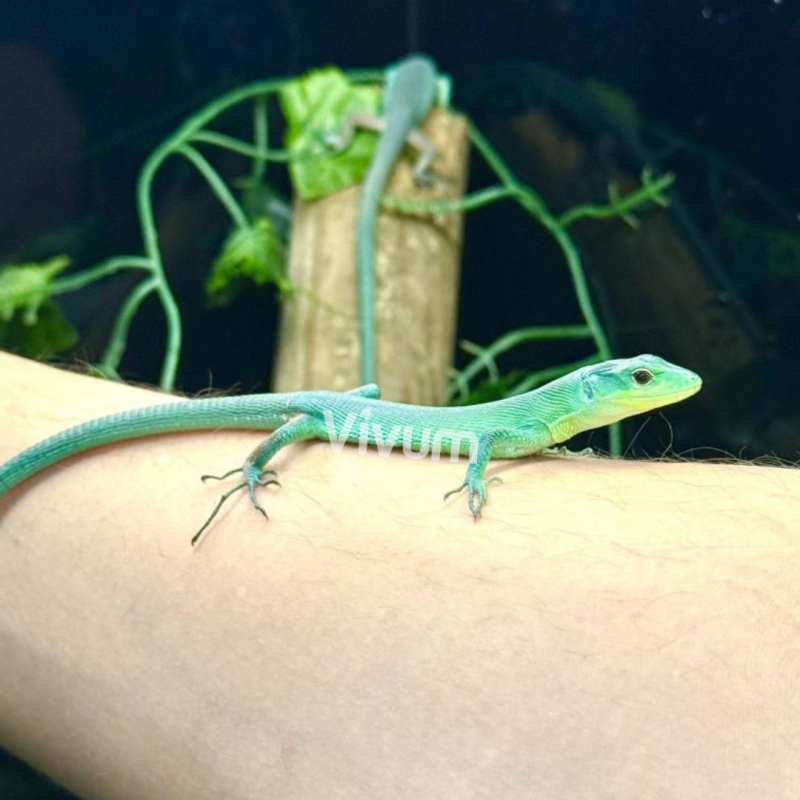

| Common Name: | Lagarto de Quilha Verde |
| Scientific Name: | Gastrophilis prasina |
| CITES Appendix: | No |
| Annex II Portuguese Ordinance No. 86/2018: | No |
Under Portuguese Law No. 95/2017 of 23 August, the sale and/or advertising of wild/exotic animals through websites or online platforms is not permitted. To find out which animals we currently have available and their conditions of sale, please get in touch with us.
 Progressive Discounts
The more you buy, the less you pay for transport
 Same Day Dispatch
For orders finalized by 3pm
 Live/Frozen Guaranteed Delivery
In live and frozen food
Size: Adults can reach 30cm
Origin: East Africa (Kenya, Tanzania)
Lifespan: Up to 10 years
Natural Habitat: Humid tropical forests of East Africa
The Lagarto de Quilha Verde (Gastropholis prasina) is an arboreal species native to the tropical forests of East Africa. It is characterised by its striking bright green colouring and keeled scales that give it a unique look. These agile animals spend most of their time among tree branches. Its exotic beauty and interesting behaviour make it a fascinating species for reptile enthusiasts with some experience.
This species requires specific care, particularly regarding humidity and temperature. Certain conditions, described in the following paragraphs, must be ensured to guarantee the health and wellbeing of these animals.
Size: A 60x45x90cm terrarium is recommended for 1 adult
Material: Glass (with mesh top for adequate ventilation)
A terrarium with a thermal gradient should be provided, with a minimum temperature of 24ºC on the cool side and around 30ºC on the warm side. The basking spot should reach 32-35ºC. At night the temperature can drop to 22ºC, but not lower. To maintain these temperatures, heat lamps can be used during the day and, if needed, a Ceramic Heat Emitter or Deep Heat Projector at night.
Regarding ultraviolet radiation, it is essential that they are exposed to moderate-intensity UVB (UVI 2-3, Ferguson Zone 2). To achieve these levels, 5 to 7% UVB tubes are recommended.
The Lagarto de Quilha Verde needs high humidity, reflecting its natural rainforest habitat. Relative humidity should be kept between 70% and 80%. To achieve this, misting the terrarium 1-2 times a day is recommended. Adding live plants also helps maintain stable humidity levels.
A water bowl with clean, fresh water should always be available, and the lizards may also drink water droplets from leaves after misting.
As an arboreal species, the terrarium should prioritise height over width. Furnish it with plenty of climbing options such as vertical logs, branches, vines and plants (artificial or live). Live plants such as bromeliads, ficus and pothos not only provide places to climb and hide but also help maintain the high humidity required.
For substrate, a mix that retains some moisture without becoming waterlogged is recommended, such as coco fibre, sphagnum moss and a top layer of leaf litter. This substrate should be at least 5-8cm deep.
Feeding habits: Insectivorous
Diet: Lagarto de Quilha Verde feed mainly on insects. They should be fed 3-4 times a week, offering a variety of prey to ensure a balanced diet.
Insects: Crickets, Roaches, Locusts, Mealworms, Waxworms, Fruit Flies.
For vitamin and mineral supplementation, it is essential to dust insects with calcium at every meal. In addition, once a week, supplement with a good-quality multivitamin complex containing vitamin D3. This supplementation is crucial to prevent metabolic bone disease.
Under Portuguese Law No. 95/2017 of 23 August, the sale and/or advertising of wild/exotic animals through websites or online platforms is not permitted. To find out which animals we currently have available and their conditions of sale, please get in touch with us.
