
| Common Name: | Anolis Sagrei |
| Scientific Name: | Anolis sagrei |
| CITES Appendix: | No |
| Annex II Portuguese Ordinance No. 86/2018: | No |
Under Portuguese Law No. 95/2017 of 23 August, the sale and/or advertising of wild/exotic animals through websites or online platforms is not permitted. To find out which animals we currently have available and their conditions of sale, please get in touch with us.
 Progressive Discounts
The more you buy, the less you pay for transport
Progressive Discounts
The more you buy, the less you pay for transport
 Same Day Dispatch
For orders finalized by 3pm
Same Day Dispatch
For orders finalized by 3pm
 Live/Frozen Guaranteed Delivery
In live and frozen food
Live/Frozen Guaranteed Delivery
In live and frozen food
Size: Adults can reach 12-20cm
Origin: Cuba, the Bahamas and the Cayman Islands
Lifespan: Up to 8 years in captivity
Natural Habitat: Terrestrial and semi-arboreal environments in tropical forests, urban and suburban areas of the Caribbean
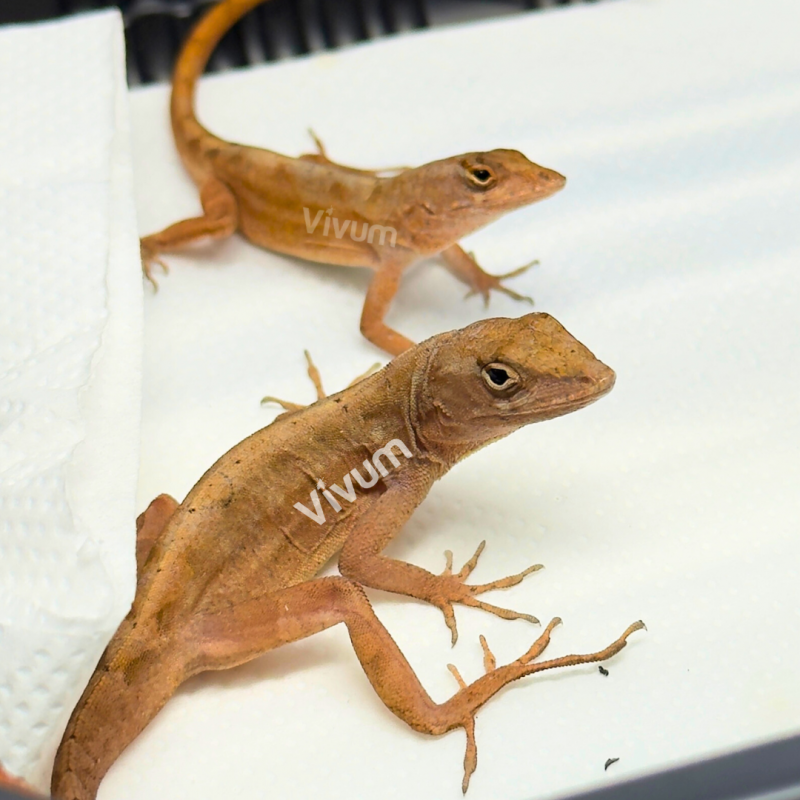
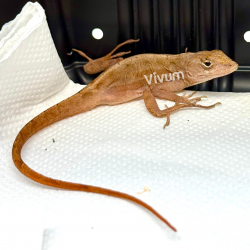
Anolis sagrei, also known as the brown anole or Cuban anole, is a small diurnal lizard that has become popular among reptile enthusiasts. It is characterised by its variable brown colouring, colour-changing ability and the males' impressive orange-red extendable dewlap. They are active, curious and relatively easy to keep, making them an excellent choice for beginners and experienced breeders alike.
Although this is a hardy, adaptable species, it is essential to provide proper husbandry to ensure its wellbeing and longevity. The following paragraphs give detailed information on the care needed to keep these fascinating lizards.
Size: Minimum of 45x45x60cm for 1 adult; 60x45x90cm for a small group
Material: Glass or mesh (with good ventilation)
A terrarium with a suitable thermal gradient should be provided. During the day, ambient temperature should be 24-27°C on the cool side and 29-32°C on the warm side, with a basking spot reaching 32-35°C. At night the temperature can drop to 18-21°C, but should not go below 18°C. To maintain these temperatures, use heat lamps during the day and, if needed, a ceramic heat emitter or Deep Heat Projector at night.
UVB radiation is essential for these animals' health. Medium-intensity UVB lamps (5-7%) positioned at an appropriate distance are recommended. ShadeDweller lamps or T8 10.0 tubes are suitable options. The photoperiod should be 10-12 hours in winter and 12-14 hours in summer, simulating natural seasonal changes.
Anolis sagrei needs moderate to high humidity to stay healthy. Relative humidity should be between 60-70%, rising naturally at night. To maintain these levels, mist the terrarium 2 to 3 times a day, especially in the morning and late afternoon. This not only keeps humidity at the right level but also provides water droplets to drink, as they prefer drinking from wet surfaces.
A shallow dish of clean, fresh water should always be available, although many individuals prefer to drink droplets from leaves and decor after misting.
As a semi-arboreal species with terrestrial tendencies, the terrarium should offer both vertical structures and ground-level areas. Furnish it with diagonal and horizontal branches of various thicknesses, plants (artificial or live) and several hides at different heights. Live plants not only beautify the terrarium but also help maintain suitable humidity.
For substrate, coco fibre, sphagnum moss or a fertiliser-free organic soil mix is recommended. The substrate should be at least 5cm deep to allow females to bury their eggs. A layer of dry leaves on top creates a more naturalistic environment and helps maintain humidity.
Feeding habits: Insectivorous
Diet: Anolis sagrei feed exclusively on live insects. Juveniles should be fed daily, while adults can be fed every 2-3 days. Offer 3-5 appropriately sized insects per meal.
Main insects: Small crickets, Roaches (Dubia, Red Runner), Fruit flies (for juveniles), Small locusts
Occasional treats: Mealworms (in moderation), Waxworms (rarely), Calcium worms ...
Appropriate size: Insects should be no larger than the width of the anole's head
Proper supplementation is crucial to prevent metabolic bone disease and nutritional deficiencies. Dust insects with calcium without D3 at every meal. In addition, use a multivitamin supplement with D3 once a week for adults and twice a week for fast-growing juveniles and breeding females.
It is important to gut-load feeder insects by giving them a nutritious diet 24-48 hours before offering them to the anoles. This significantly increases the nutritional value of the prey.
Under Portuguese Law No. 95/2017 of 23 August, the sale and/or advertising of wild/exotic animals through websites or online platforms is not permitted. To find out which animals we currently have available and their conditions of sale, please get in touch with us.