
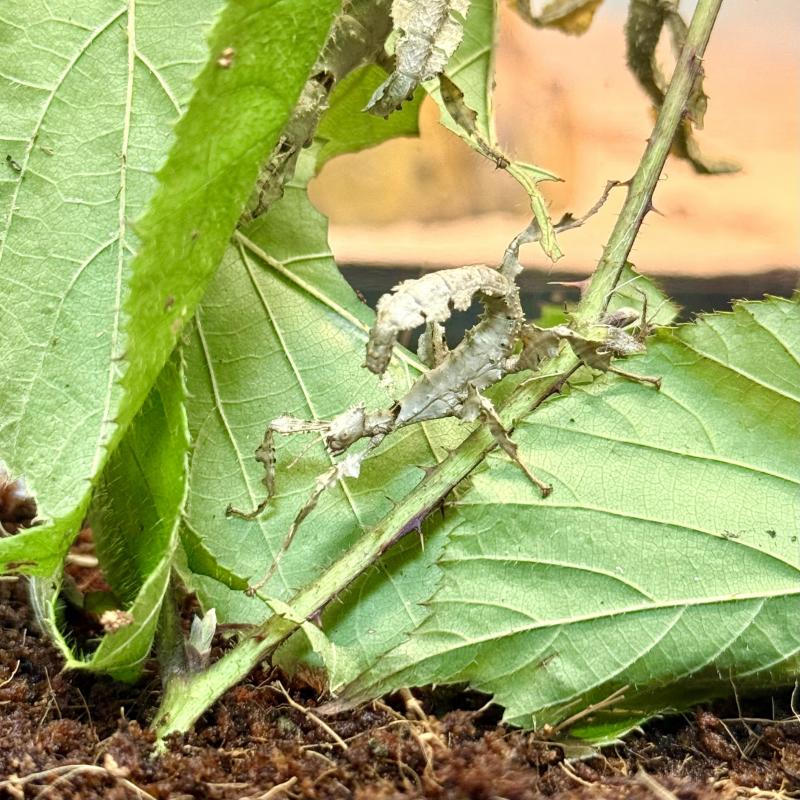
| Common Name: | Inseto Pau Gigante Australiano |
| Scientific Name: | Extatosoma tiaratum |
 Progressive Discounts
The more you buy, the less you pay for transport
 Same Day Dispatch
For orders finalized by 3pm
 Live/Frozen Guaranteed Delivery
In live and frozen food
Size: Adults can reach 15cm
Origin: Australia
Lifespan: Around 1 to 2 years
Natural Habitat: Extatosoma tiaratum mainly inhabits the rainforests of northern Australia, living in dense vegetation where it camouflages itself among leaves and twigs.
Extatosoma tiaratum, also known as the "Inseto Pau Gigante Australiano", is a fascinating species, very popular as an exotic pet thanks to its unusual appearance and interesting behaviour.
Although this is an easy species to keep, you should pay attention to a few aspects and ensure certain conditions, which you will find in the following paragraphs.
Size: For a pair of Extatosoma tiaratum, a minimum terrarium of 30x30x45 cm is recommended, taller than it is wide to suit the species' arboreal behaviour.
Material: Glass
Extatosoma tiaratum should be kept at a temperature between 22ºC and 26ºC. In winter or cooler rooms, a thermostat-controlled Heat Mat can be used to maintain the ideal temperature.
This species does not need UVB lighting, but should be kept with a natural-like light/dark cycle of around 12 hours of light a day.
As this species lives in tropical areas, it is important to maintain a relative humidity of around 70-80%. This can be done by misting the terrarium 1 to 2 times a day, while avoiding waterlogging.
Recreate a forest environment with branches and twigs for the insects to cling to and climb. Logs, cork bark and plants (artificial or live) can be used to decorate the space, simulating the species' natural habitat and allowing them to camouflage.
Feeding habits: Herbivorous
Diet: Extatosoma tiaratum feeds mainly on eucalyptus leaves, but in captivity it can also eat rose, bramble, oak and raspberry leaves. Make sure the leaves are free of pesticides and other chemicals.
