

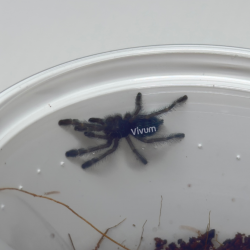
| Common Name: | Tarântula Caribena versicolor |
| Scientific Name: | Avicularia/Caribena versicolor |
| CITES Appendix: | No |
| Annex II Portuguese Ordinance No. 86/2018: | Yes |
Under Portuguese Law No. 95/2017 of 23 August, the sale and/or advertising of wild/exotic animals through websites or online platforms is not permitted. To find out which animals we currently have available and their conditions of sale, please get in touch with us.
 Progressive Discounts
The more you buy, the less you pay for transport
 Same Day Dispatch
For orders finalized by 3pm
 Live/Frozen Guaranteed Delivery
In live and frozen food
Size: As adults, females can reach a 14-15cm leg span; males are considerably smaller
Origin: Martinique, Lesser Antilles (Caribbean)
Lifespan: Females up to 12 years; males 2 to 3 years
Natural Habitat: They inhabit the tree canopy and vegetation of Martinique's humid rainforests, where they build silk retreats among branches and foliage
The Tarântula Avicularia versicolor — also known as the Antilles Pinktoe Tarantula or Martinique Pinktoe — is one of the most stunning tarantula species available in captivity. Spiderlings hatch with vibrant metallic blue colouring and, through successive moults, transform into adults with iridescent shades of emerald green, red, purple and pink — a truly unique metamorphosis in the arthropod world.
It is an arboreal New World species with a generally docile temperament, building elaborate silk tunnels at the highest points of the terrarium. Although visually spectacular and relatively accessible to keepers with some experience, it requires particular attention to ventilation and humidity balance, especially when young. With the right conditions, it is an extremely rewarding tarantula and an excellent display species.
Although this is an intermediate-level species, you should pay attention to a few critical aspects — especially ventilation — which you will find in the following paragraphs.
Size: A 30x30x45cm (LxWxH) terrarium is recommended for 1 adult; height takes priority over floor space
Material: Glass or acrylic with cross-ventilation (side and top openings)
Ventilation is the most critical factor in keeping this species. Stagnant air — even if humid — can be fatal and is responsible for the so-called Sudden Avic Death Syndrome (SADS), sudden death linked to stagnant humidity and poor air circulation. The terrarium should have ventilation openings both on the sides and at the top to create a gentle, continuous airflow.
Provide at least one vertical cork tube hide, which will serve as an anchor point for the web. The species builds extensive tubular retreats and needs enough space and structure to do so.
This species does not need extra heat sources in most homes, as indoor room temperature is usually adequate. The ideal temperature is between 24ºC and 28ºC during the day. Night temperatures can drop to 20ºC without problems; prolonged periods below this are not recommended.
The Avicularia versicolor does not need UVB. Avoid direct exposure to intense sunlight or radiant heat sources that could create hot spots in the terrarium.
The ideal relative humidity is between 70% and 80%. However, it is essential that this humidity is dynamic rather than stagnant: the terrarium should partially dry out between mistings, allowing a wet/dry cycle that replicates natural tropical conditions. Moderately mist the walls and vegetation (never the animal directly), and let the terrarium dry over the next 24 hours before misting again.
A small container of clean, fresh water should always be available. The tarantula may also drink the water droplets on the terrarium walls after misting.
The terrarium should prioritise vertical structure. Equip it with upright cork tubes, branches, artificial or live plants (e.g. Pothos, bromeliads) and other elements that let the tarantula build its web in the highest areas. This species is a prolific web builder and benefits greatly from plenty of anchor points.
The substrate should be 5 to 8cm deep, made of coco fibre, peat or a tropical terrarium mix. It should be kept slightly damp in the deeper layers but dry on the surface — this layering helps maintain ambient humidity without waterlogging or stagnation. Spiderlings are especially sensitive to overly damp substrate.
Feeding habits: Carnivorous/Insectivorous
Diet: The Avicularia versicolor is an active predator. Prey should be no larger than the tarantula's abdomen. Adults should be fed every 7 to 14 days; juveniles every 5 to 7 days; spiderlings every 3 to 5 days. Always remove uneaten prey after 24 hours to avoid stressing the animal.
Insects: Roaches (e.g. Blaptica dubia), Crickets, Mealworms, Superworms (for adults). For spiderlings: Fruit Flies (Drosophila spp.) and small Crickets.
Tarantulas do not need vitamin or mineral supplements — unlike reptiles, they get all the nutrients they need from the prey they eat. Do not dust prey with calcium or vitamins, as this offers no benefit and can be harmful. Make sure feeder insects are captive-bred and properly fed (gut-loading) before offering them.
Under Portuguese Law No. 95/2017 of 23 August, the sale and/or advertising of wild/exotic animals through websites or online platforms is not permitted. To find out which animals we currently have available and their conditions of sale, please get in touch with us.
