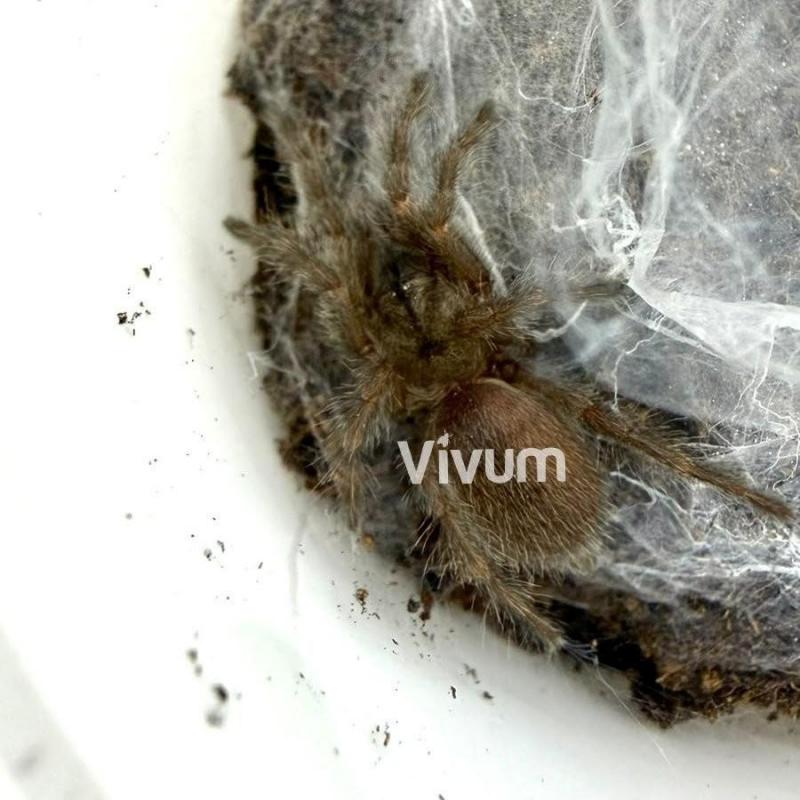
Generic photo of the species
| Common Name: | Tarântula Monocentropus balfouri |
| Scientific Name: | Monocentropus balfouri |
| CITES Appendix: | No |
| Annex II Portuguese Ordinance No. 86/2018: | Yes |
Under Portuguese Law No. 95/2017 of 23 August, the sale and/or advertising of wild/exotic animals through websites or online platforms is not permitted. To find out which animals we currently have available and their conditions of sale, please get in touch with us.
 Progressive Discounts
The more you buy, the less you pay for transport
 Same Day Dispatch
For orders finalized by 3pm
 Live/Frozen Guaranteed Delivery
In live and frozen food
Size: Adults can reach a legspan of 12 to 15cm
Origin: Socotra Island (Yemen), in the Indian Ocean, off the Horn of Africa
Lifespan: Females up to 10 to 14 years; males up to 3 to 4 years
Natural Habitat: It inhabits arid, rocky areas of Socotra Island, up to around 850m altitude, sheltering in rock crevices, under stones and in shallow silk-lined burrows
The Monocentropus balfouri, commonly known as the Socotra Island Blue Baboon, is an Old World tarantula endemic to Socotra Island. It is highly prized for its unique colouring — bluish-grey legs, beige carapace and an abdomen with dark patterns — and for its prolific webbing, with which it creates tunnels and retreats throughout the terrarium.
It also shows unusual behaviour for a tarantula: it tolerates living with others and is sometimes kept in communal groups of individuals of the same age. This practice does, however, require experience, adequate space and plentiful food, as the risk of cannibalism is never zero. Although considered calmer than many other Old World tarantulas, it is fast, has no urticating hairs and has potent venom, and may adopt a threat posture when disturbed. Handling should be avoided, and it is best suited to keepers who already have some experience with tarantulas.
Although it is a hardy species, you should pay attention to a few aspects and ensure certain conditions, which you will find in the following paragraphs.
Size: A terrarium of at least 30x30x30cm is recommended for 1 adult (prioritise floor space over height)
Material: Glass or acrylic with good ventilation and a secure lid
The Monocentropus balfouri adapts well to room temperatures between 22ºC and 28ºC. In most cases no additional heat source is needed. If necessary, you can use a Heat Mat placed on the side — never under the terrarium — always controlled by a thermostat.
Ventilation is important: good airflow prevents humidity from building up and stops mould and mites from spreading. The terrarium should have cross-ventilation openings.
Tarantulas do not need any UVB or special lighting. If you choose to light the terrarium for aesthetic purposes, use a cool, low-intensity light source to avoid overheating the space.
Coming from an arid habitat, this species prefers a mostly dry environment with a relative humidity of 50% to 60%. Simply moisten one corner of the substrate lightly every one to two weeks, keeping the rest of the terrarium dry. Avoid keeping the substrate permanently damp.
A shallow dish of fresh, clean water should always be available. Although tarantulas rarely drink visibly, the water dish helps maintain suitable humidity and serves as a source of hydration, especially during moulting.
It is a terrestrial, opportunistic burrower. The substrate should be at least 10 to 15cm deep for adults; you can use coco fibre, peat, or a mix of additive-free soil and coco fibre.
Furnish the terrarium with at least one hide (cork tube or slab, partly buried), as well as branches, roots and some dry leaves to serve as anchor points for the web. Over time the tarantula will cover much of the terrarium with silk; this webbing is part of the species' natural behaviour and should not be removed during maintenance.
Feeding habits: Carnivorous/Insectivorous
Diet: Juveniles should be fed once or twice a week with prey sized to their abdomen. Adults can be fed every 10 to 14 days, depending on appetite and the appearance of the abdomen. In communal groups, offer enough prey for all animals and watch how the food is shared out. Always remove uneaten prey after 24 hours, especially during moulting.
Insects: Crickets, Roaches (Blaptica dubia, Shelfordella lateralis), Locusts, Morio Worms (with the head crushed, to stop them burrowing) and Mealworms (as an occasional treat).
Tarantulas do not need vitamin or mineral supplements, as they obtain all the nutrients they need from the prey they eat. To maximise the nutritional value of the prey, feed the insects a nutrient-rich diet (gut-loading) in the 24 to 48 hours before offering them to the tarantula. Avoid offering wild-caught prey, as it may carry parasites or pesticides harmful to the animal.
Under Portuguese Law No. 95/2017 of 23 August, the sale and/or advertising of wild/exotic animals through websites or online platforms is not permitted. To find out which animals we currently have available and their conditions of sale, please get in touch with us.