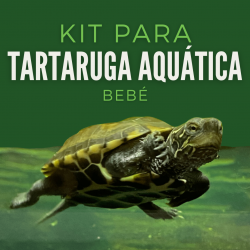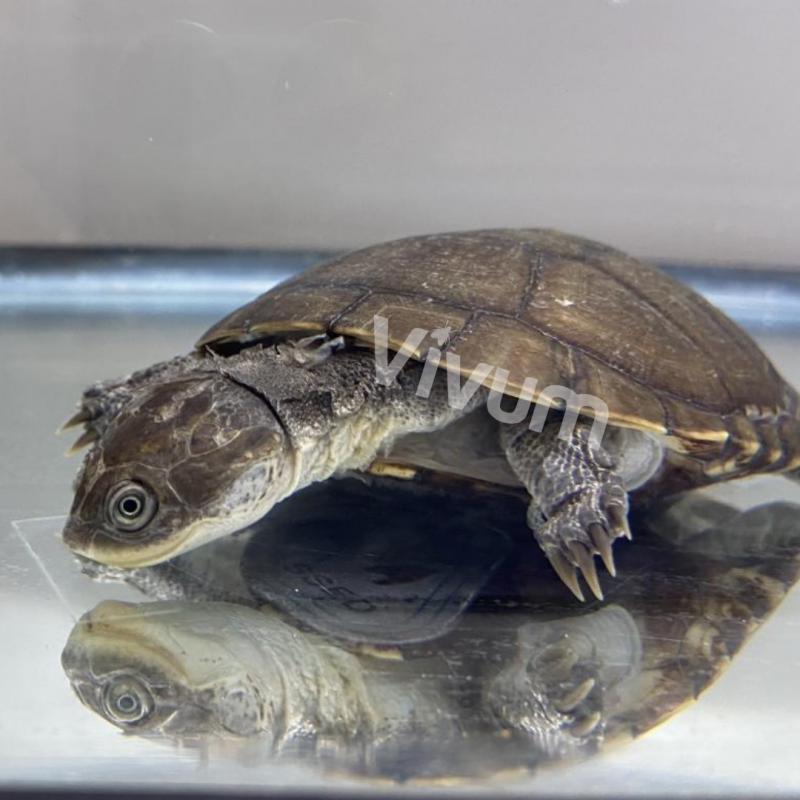
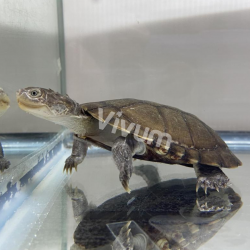
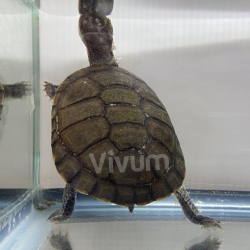
| Common Name: | Tartaruga de Capacete Africana |
| Scientific Name: | Pelomedusa subrufa |
| CITES Appendix: | No |
| Annex II Portuguese Ordinance No. 86/2018: | No |
Under Portuguese Law No. 95/2017 of 23 August, the sale and/or advertising of wild/exotic animals through websites or online platforms is not permitted. To find out which animals we currently have available and their conditions of sale, please get in touch with us.
 Progressive Discounts
The more you buy, the less you pay for transport
Progressive Discounts
The more you buy, the less you pay for transport
 Same Day Dispatch
For orders finalized by 3pm
Same Day Dispatch
For orders finalized by 3pm
 Live/Frozen Guaranteed Delivery
In live and frozen food
Live/Frozen Guaranteed Delivery
In live and frozen food
O conteúdo (Texto e Fotografias) desta página está protegido por direitos de autor. A sua cópia, redistribuição ou modificação sem autorização prévia poderá resultar em responsabilização legal.
Size: Adults can reach 20 cm in length
Origin: Sub-Saharan Africa
Lifespan: Up to 50 years
Natural Habitat: They mainly inhabit still waters such as swamps, marshes, pools and lakes.
The Tartaruga de Capacete Africana is a very energetic aquatic turtle species. Adults reach an intermediate size of 15 to 20cm. It is very active, which makes it fascinating to watch in the aquaterrarium. As it can be somewhat aggressive, avoid housing it with turtles of other species or even with smaller Tartarugas de Capacete Africanas.
Although this is a relatively easy species to keep, you should pay attention to a few aspects and ensure certain conditions, which you will find in the following paragraphs.
Size: Minimum 90x40x30cm / 55 litres for 1 adult
Material: Glass
Although mainly aquatic, the Tartaruga de Capacete Africana also likes to venture onto land to bask, dig and hide. A basking area at 28-32ºC should be provided. A 5-7% UVB lamp should also be used to provide the right levels of ultraviolet radiation for this aquatic turtle species. Water temperature should be kept between 24-28ºC with a submersible aquarium heater.
A filter is needed to keep the water clean, as these animals produce a lot of waste. Use a filter with a low flow rate or one that can be adjusted, as this species prefers calm water.
Sand or small stones on the bottom of the aquarium make it easier for the turtles to move around the bottom. Rocks, logs and live/artificial plants can be used to decorate the water section of the terrarium. The dry section should have a loose substrate for digging, decorated with plants, stones and logs to hide among.
Feeding habits: Mainly Carnivorous
- Foods
Staple: The staple diet should be a commercial food formulated specifically for aquatic turtles.
Occasional: Freshwater Fish, Crickets, Roaches, Snails, Mealworms, Waxworms, Calcium Worms, White Meat (Chicken or Turkey)...
Under Portuguese Law No. 95/2017 of 23 August, the sale and/or advertising of wild/exotic animals through websites or online platforms is not permitted. To find out which animals we currently have available and their conditions of sale, please get in touch with us.