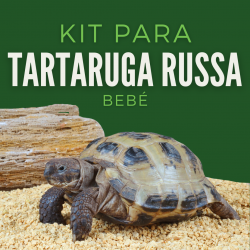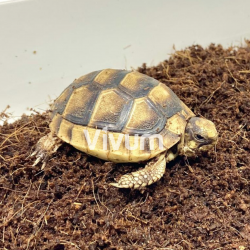


| Common Name: | Tartaruga Marginata |
| Scientific Name: | Testudo marginata |
| CITES Appendix: | Yes, IIA |
| Annex II Portuguese Ordinance No. 86/2018: | No |
Under Portuguese Law No. 95/2017 of 23 August, the sale and/or advertising of wild/exotic animals through websites or online platforms is not permitted. To find out which animals we currently have available and their conditions of sale, please get in touch with us.
 Progressive Discounts
The more you buy, the less you pay for transport
Progressive Discounts
The more you buy, the less you pay for transport
 Same Day Dispatch
For orders finalized by 3pm
Same Day Dispatch
For orders finalized by 3pm
 Live/Frozen Guaranteed Delivery
In live and frozen food
Live/Frozen Guaranteed Delivery
In live and frozen food
O conteúdo (Texto e Fotografias) desta página está protegido por direitos de autor. A sua cópia, redistribuição ou modificação sem autorização prévia poderá resultar em responsabilização legal.
Size: Adults can reach a shell length of 35cm
Origin: Southern Greece and Italy
Lifespan: Can exceed 80 years in captivity
Natural Habitat: They inhabit semi-arid areas of southern Greece and Italy.
The Tartaruga Marginata is a beautiful, easy-to-keep tortoise species. It is often the first tortoise for many keepers.
Although this is not a difficult species to keep, you should pay attention to a few aspects and ensure certain conditions, which you will find in the following paragraphs.
Size: When small, they can be kept in terrariums, aquariums or tortoise tables with a base of around 90x45cm. As they grow, the terrarium size should be increased. As a rule, the bigger the better. The recommended minimum size for a pair of Tartarugas Marginatas is 2x1m. Adults can be kept outdoors, provided they have suitable conditions for digging and hides to shelter in.
Material: Glass or Wood
A basking area large enough to fully cover the tortoise should be provided, with a temperature of up to 37ºC. The rest of the terrarium can be kept at no less than 20ºC. At night temperatures can safely drop to 15ºC.
A 12% T5 UVB tube should also be used to provide the right levels of ultraviolet radiation for this tortoise species.
Coming from semi-desert and arid areas, this species does not need high humidity. However, especially for younger animals, it helps to provide humid hides where the tortoises can shelter.
They should also always have a container of clean, fresh water available to drink from and soak in.
You can decorate the terrarium with branches, stones and hides. Choose a substrate that allows the tortoise to dig. The most recommended options include Tortoise-Specific Substrates and coco fibre/humus.
Feeding habits: Herbivorous.
- Foods
Staple: Around 70% of the diet should be based on vegetables, grasses and hay.
Occasional: You can supplement with many types of leaves and herbs such as hibiscus (including the flower), thistles, rose, cherry, dandelion (leaf and flower), chamomile, various flowers, rosette, kohlrabi, alfalfa, sunflower (leaf and flower), plane tree, mulberry, cactus (without spines), clover, etc.
- Supplementation
Dust the food with a quality Vitamin and Mineral Supplement with Vitamin D3.
Under Portuguese Law No. 95/2017 of 23 August, the sale and/or advertising of wild/exotic animals through websites or online platforms is not permitted. To find out which animals we currently have available and their conditions of sale, please get in touch with us.