

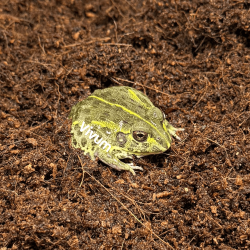
| Common Name: | Rã Touro Africana |
| Scientific Name: | Pyxicephalus adspersus |
| CITES Appendix: | No |
| Annex II Portuguese Ordinance No. 86/2018: | No |
Under Portuguese Law No. 95/2017 of 23 August, the sale and/or advertising of wild/exotic animals through websites or online platforms is not permitted. To find out which animals we currently have available and their conditions of sale, please get in touch with us.
 Progressive Discounts
The more you buy, the less you pay for transport
 Same Day Dispatch
For orders finalized by 3pm
 Live/Frozen Guaranteed Delivery
In live and frozen food
Size: Males can reach 25cm; females are significantly smaller, reaching 15cm
Origin: Sub-Saharan Africa (South Africa, Zimbabwe, Namibia, Zambia, Tanzania, Kenya and neighbouring regions)
Lifespan: Up to 40 years in captivity
Natural Habitat: They inhabit savannahs, grasslands and lowlands throughout sub-Saharan Africa, usually near temporary or permanent bodies of water
The Rã Touro Africana (Pyxicephalus adspersus) is the second-largest frog species in the world, surpassed only by the Goliath Frog (Conraua goliath). It is characterised by its robust, rounded body, olive-green colouring with a yellowish or orange belly in males, and its remarkable longevity — it can live for several decades in captivity. It is a semi-fossorial, diurnal species, well adapted to alternating dry and rainy seasons in its natural habitat, and can aestivate during prolonged droughts.
Its voracious temperament and strong personality make it one of the most popular frogs in the pet trade. However, it requires specific care, particularly regarding diet and weight control. It must always be kept alone, as it is an opportunistic predator able to eat any animal that fits in its mouth, including others of its own species.
Although this is a relatively hardy species, you should pay attention to a few aspects and ensure certain conditions, which you will find in the following paragraphs.
Size: A minimum terrarium of 90x45x45cm is recommended for 1 adult male; a 60x45x45cm terrarium is enough for adult females
Material: Glass or Wood (with a secure lid, as these animals can push with considerable force)
Housing: The Rã Touro Africana must always be kept alone. Housing it with others, even of similar size, carries a serious risk of cannibalism.
Set up a terrarium with a thermal gradient, with an ambient temperature of 24ºC to 28ºC and a basking spot of about 30-32ºC. At night the temperature should not drop below 20ºC. To reach these temperatures, use a low-wattage lamp over one end of the terrarium, controlled by a thermostat. Avoid heat sources under the terrarium (heat mats), as they can dry out the substrate excessively and make humidity harder to control.
As a diurnal species, the Rã Touro Africana benefits from low-intensity UVB (UVI 1-2, Ferguson Zone 1-2), which supports vitamin D3 synthesis and strengthens the immune system. A ShadeDweller or equivalent low-UV lamp is recommended. A regular light cycle of 10 to 14 hours of daylight, depending on the season, is also important.
The Rã Touro Africana needs a relative humidity between 60% and 80%. Humidity should be monitored with a digital hygrometer and maintained by daily misting with dechlorinated water. A water dish large enough for the animal to submerge and fully hydrate should always be available — frogs absorb water mainly through their skin. This dish should be kept clean, with fresh water changed daily. It is also important for the substrate to stay damp (but not waterlogged) throughout its depth.
The Rã Touro Africana is semi-fossorial and spends much of its time buried in the substrate. The substrate should be at least 10cm deep so the animal can bury itself completely. A mix of coco fibre, fertiliser-free soil and, optionally, sphagnum moss for moisture retention is recommended. Avoid too much loose sphagnum moss, as it can be swallowed accidentally while feeding.
Decor should be simple and functional: include at least one sturdy hide (log, flat stone or robust aquarium ornament), and add branches and rocks for enrichment if you wish. Live plants can be included, but as these animals tend to destroy them when digging, artificial plants are a more durable option. All decor must be safe and free of edges that could injure the animal's sensitive skin.
Feeding habits: Carnivorous
Juvenile Diet: Feed daily with appropriately sized insects
Adult Diet: Feed 2 to 3 times a week
⚠️ Beware of Obesity: The Rã Touro Africana is extremely prone to obesity in captivity. These are ambush predators with a voracious appetite and no natural satiety mechanism. Overfeeding is one of the most common causes of health problems in this species and can seriously shorten the animal's lifespan. Strictly follow the recommended frequency and amounts.
Insects and invertebrates (staple diet): Crickets, Roaches, Locusts, Mealworms, Waxworms (in moderation, high in fat), Superworms, Earthworms...
Small vertebrates (adults, occasionally): Mice (pinkies or fuzzies for young animals; adult mice for larger specimens). Note: rodents should be offered frozen/thawed or with tongs, never live. They should make up only a small part of the diet, as their high fat content can contribute to obesity.
Supplementation is essential to prevent metabolic bone disease, which is very common in captive amphibians. Dust insects with Calcium Powder (without D3) at every meal. Once a week, replace the plain calcium with a quality Multivitamin Complex that includes Vitamin D3.
Under Portuguese Law No. 95/2017 of 23 August, the sale and/or advertising of wild/exotic animals through websites or online platforms is not permitted. To find out which animals we currently have available and their conditions of sale, please get in touch with us.
