
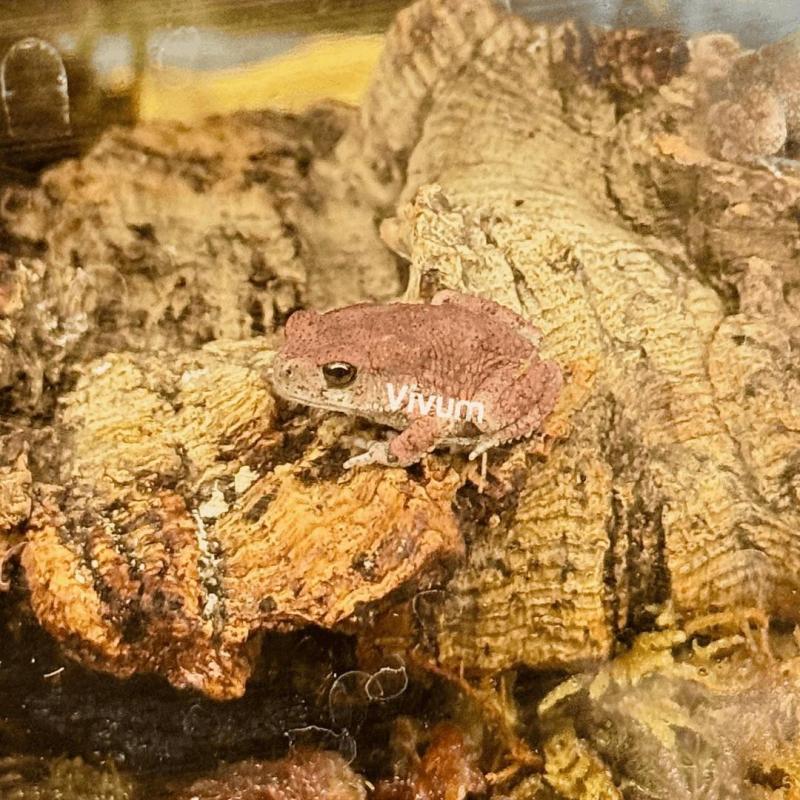
Generic photo of the species
| Common Name: | Sapo Berebere |
| Scientific Name: | Sclerophrys mauritanica |
| CITES Appendix: | No |
| Annex II Portuguese Ordinance No. 86/2018: | No |
Under Portuguese Law No. 95/2017 of 23 August, the sale and/or advertising of wild/exotic animals through websites or online platforms is not permitted. To find out which animals we currently have available and their conditions of sale, please get in touch with us.
 Progressive Discounts
The more you buy, the less you pay for transport
 Same Day Dispatch
For orders finalized by 3pm
 Live/Frozen Guaranteed Delivery
In live and frozen food
Size: Adults can reach 13–16cm (females tend to be larger)
Origin: North Africa — Morocco, Algeria, Tunisia and Western Sahara
Lifespan: Up to 15 years in captivity
Natural Habitat: They inhabit dry woodland and scrub, riverbanks, farmland and pastures in the Mediterranean and semi-arid regions of North Africa
The Sapo Berebere (Sclerophrys mauritanica), also known as the Sapo Mourisco, Sapo Marroquino or Sapo Mauritânico (in English: Berber Toad / Moroccan Toad / Mauritanian Toad), is one of the largest toads in the Bufonidae family and the largest amphibian in North Africa. The species was historically classified as Bufo mauritanicus and Amietophrynus mauritanicus, synonyms still common in the literature. It is distinguished by its robust build, prominent parotoid glands and beige to olive-green base colour, speckled with well-defined orange or red blotches. The belly is white with small grey spots. There is marked sexual dimorphism: males are smaller and, in the breeding season, develop a vocal sac and nuptial pads on the front toes.
They are terrestrial, crepuscular and nocturnal animals with a relatively calm temperament that adapts well to captivity. Its relative rarity in the European reptile and amphibian trade, together with its impressive looks and curious behaviour, make the Sapo Berebere increasingly popular with keepers who have some amphibian experience.
Although it is a hardy species, certain specific conditions must be ensured for its long-term health and wellbeing, which you will find in the following paragraphs.
Size: Minimum 80x40x40cm for 1 adult; 100x50x50cm for a pair
Material: Glass (with a mesh lid for adequate ventilation)
The Sapo Berebere comes from Mediterranean and semi-arid climates, so it tolerates moderate temperatures well. During the day, the ambient temperature should be between 22ºC and 26ºC, with a basking spot no higher than 30ºC. At night the temperature can drop to 18ºC. In most cases no extra heating is needed in summer; in winter, a Ceramic Heat Emitter or a thermostat-controlled Heat Mat can be used to maintain the necessary minimum temperatures.
As with other amphibians, the benefits of UVB for this species are not fully documented. However, exposure to low UVB levels (Ferguson Zone 1, UVI 0.5–1) using a ShadeDweller or equivalent lamp is recommended, as it supports vitamin D3 synthesis in the skin and contributes to overall wellbeing. The photoperiod should follow a 12-hour light/12-hour dark cycle, which can be adjusted seasonally to encourage natural behaviour.
The Sapo Berebere lives in transitional environments between dry and humid areas, so terrarium humidity should be kept between 50% and 70%. Mist the terrarium regularly (once a day or every other day) to maintain these levels, paying special attention to dampening the hides.
A shallow, clean water dish with chlorine-free water, wide enough for the animal to hydrate easily, should always be available. Amphibians absorb water through their skin rather than drinking, so water quality is crucial to their health.
The terrarium should prioritise floor space, as this is a terrestrial species. For substrate, a mix of coco fibre and fertiliser-free organic soil at least 8–10cm deep is recommended to allow digging and maintain suitable microclimates. You can also add a layer of natural dead leaves for enrichment.
Decor should include several hides (cork, logs, flat rocks or amphibian-specific hides) spread throughout the terrarium. Live Mediterranean plants or artificial plants can be used to create a more naturalistic setup. Make sure all decor is stable and cannot collapse onto the animal.
Feeding habits: Insectivorous / Invertivorous
Diet: The Sapo Berebere is a voracious, opportunistic feeder. Adults should be fed 3 to 4 times a week; juveniles can be fed daily in amounts suited to their size. As this species is prone to obesity in captivity, it is important not to overfeed and to vary the prey regularly.
Insects and invertebrates: Crickets, Roaches, Locusts, Mealworms, Waxworms (in moderation), Earthworms, Calcium Worms...
Correct supplementation is essential to prevent nutritional deficiencies in captive amphibians. All prey should undergo gut-loading (fed on vegetables and quality feed) for 24–48 hours before being offered. For direct supplementation, dust prey with Calcium Powder (without D3) at 5 meals a week, alternating with a quality Multivitamin Complex (with Vit. D3) once a week.
Under Portuguese Law No. 95/2017 of 23 August, the sale and/or advertising of wild/exotic animals through websites or online platforms is not permitted. To find out which animals we currently have available and their conditions of sale, please get in touch with us.