
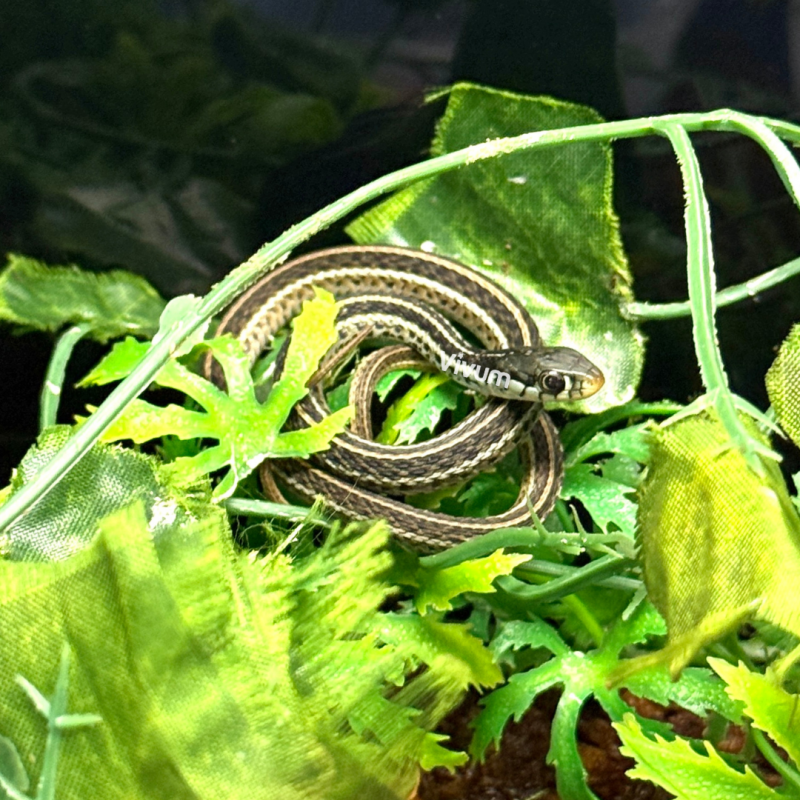

| Common Name: | Garter Snake Azul |
| Scientific Name: | Thamnophis sirtalis similis |
| CITES Appendix: | No |
| Annex II Portuguese Ordinance No. 86/2018: | Yes |
Under Portuguese Law No. 95/2017 of 23 August, the sale and/or advertising of wild/exotic animals through websites or online platforms is not permitted. To find out which animals we currently have available and their conditions of sale, please get in touch with us.
 Progressive Discounts
The more you buy, the less you pay for transport
Progressive Discounts
The more you buy, the less you pay for transport
 Same Day Dispatch
For orders finalized by 3pm
Same Day Dispatch
For orders finalized by 3pm
 Live/Frozen Guaranteed Delivery
In live and frozen food
Live/Frozen Guaranteed Delivery
In live and frozen food
Size: Adults usually reach 55–90 cm, with some larger females approaching 100 cm.
Origin: North America (Canada, United States and northern Mexico, depending on the population).
Lifespan: 10–15 years in captivity, when kept with proper care.
Natural Habitat: A highly adaptable species found in wetlands, river and lake margins, marshes, damp meadows, open woodland and suburban areas. It is often associated with nearby water, but is not strictly aquatic.
The Garter Snake Azul is a diurnal, active and curious colubrid, known for its pattern of longitudinal stripes in bluish or blue-green tones, which varies by locality. It is one of the most studied and widely kept North American snakes, valued for its generally docile behaviour and high tolerance of handling.
It is a species suited to keepers with some experience, mainly due to its varied diet and the need for proper nutritional management.
Size: Minimum 90×45×45 cm for 1 adult. A longer enclosure is recommended for large females.
Material: Glass or PVC. The most important thing is to ensure good ventilation, thermal stability and easy humidity control.
A thermal gradient should be created with around 24–25 °C on the cool side and a basking spot of 30–32 °C. At night, the temperature can drop to 20–22 °C.
Heating can be provided by a daytime heat lamp and, if needed, a ceramic heat emitter or deep heat projector at night, always controlled by a thermostat.
As a diurnal species, it benefits from low to medium UVB exposure (Ferguson Zone 2, UVI 1–3). 5–7% UVB tube lamps are recommended, with a photoperiod of around 12 hours.
The ideal relative humidity is between 45% and 60%, depending on ventilation and substrate. There should always be a water container large enough for partial or full immersion.
The water should be changed daily. The species uses water for hydration, thermoregulation and, occasionally, during shedding.
The terrarium should provide a humid terrestrial environment. The substrate can be made up of fertiliser-free soil, coco fibre and sphagnum moss, 5–8 cm deep.
Provide several hides at both thermal ends, along with logs, branches and vegetation for visual cover and environmental enrichment. Flat rocks can be used for basking.
Feeding habits: Opportunistic carnivore.
Natural diet: Amphibians, earthworms, slugs, small fish and occasionally small vertebrates.
Feeding frequency: Juveniles every 4–5 days; adults every 7–10 days.
Invertebrates: Earthworms (Lumbricus terrestris), slugs.
Safe fish (occasionally): Trout, salmon. Should be used in moderation.
Rodents: Newborn or juvenile mice (pinkies/fuzzies), preferably frozen/thawed.
Fish to avoid: Goldfish, rosy reds, sardines, mackerel and other thiaminase-rich fish, due to the risk of vitamin B1 deficiency.
In captivity, a diet based mainly on whole prey (rodents) is the most balanced and safest long-term option.
Supplementation should be adjusted to the diet provided.
Diet with fish: Whenever fish is part of the diet, vitamin B1 (thiamine) supplementation is recommended.
Rodent-based diet: When the diet consists mainly of whole prey, regular supplementation is not usually necessary.
Calcium: Calcium powder without D3 can be offered occasionally, especially with mixed diets. The ideal calcium:phosphorus ratio is approximately 2:1.
Vitamin D3: In animals kept with adequate UVB, supplementation should be minimal or unnecessary.
Under Portuguese Law No. 95/2017 of 23 August, the sale and/or advertising of wild/exotic animals through websites or online platforms is not permitted. To find out which animals we currently have available and their conditions of sale, please get in touch with us.