

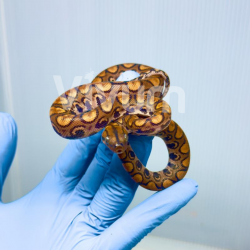

| Common Name: | Boa Arco-Íris |
| Scientific Name: | Epicrates cenchria cenchria |
| CITES Appendix: | Yes, IIB |
| Annex II Portuguese Ordinance No. 86/2018: | Yes |
Under Portuguese Law No. 95/2017 of 23 August, the sale and/or advertising of wild/exotic animals through websites or online platforms is not permitted. To find out which animals we currently have available and their conditions of sale, please get in touch with us.
 Progressive Discounts
The more you buy, the less you pay for transport
Progressive Discounts
The more you buy, the less you pay for transport
 Same Day Dispatch
For orders finalized by 3pm
Same Day Dispatch
For orders finalized by 3pm
 Live/Frozen Guaranteed Delivery
In live and frozen food
Live/Frozen Guaranteed Delivery
In live and frozen food
Size: Adults can reach 150-200cm
Origin: South America (Brazil, Venezuela, the Guianas, Suriname)
Lifespan: Up to 25 years in captivity
Natural Habitat: It inhabits the humid tropical forests of South America
Epicrates cenchria cenchria, known as the Boa Arco-Íris, is one of the most impressive and sought-after snake species in the reptile-keeping world. Its name comes from the unique iridescence of its scales, which reflect rainbow colours when exposed to light. It is a semi-arboreal species, characterised by distinctive geometric patterns in shades of brown, orange and red, combined with an extraordinary metallic sheen.
Despite its exceptional beauty, the Boa Arco-Íris requires specific care, especially regarding high humidity and stable temperatures. It is recommended for keepers with some experience, as it needs strictly controlled environmental conditions to thrive in captivity. With proper care, it can become a fascinating and long-lived pet.
You should pay attention to a few aspects and ensure certain conditions, which you will find in the following paragraphs.
Size: Minimum 120x60x60cm for 1 adult. Young snakes can be kept in considerably smaller terrariums.
Material: Glass or PVC (with adequate ventilation).
You should set up a terrarium with a thermal gradient, with a minimum temperature of 26ºC on the cool side and around 30-32ºC on the warm side. At night, the temperature can drop to 24ºC, but should not go below this. To maintain these temperatures, you can use thermostat-controlled heat mats or ceramic heat emitters.
Although not essential, as they are mainly nocturnal snakes, daytime exposure to a UVI between 0 and 3 (Ferguson Zone 1-2) is recommended. To achieve these UV levels you can use ShadeDweller UV lamps.
Humidity is critical to keeping this species successfully. Relative humidity should be kept between 75% and 85%, reflecting its natural rainforest habitat. To achieve these levels, it is recommended to mist the terrarium daily, use an automatic misting system or place water containers that increase evaporation. Although this species benefits from high humidity, close attention must be paid to ventilation, as stagnant, saturated air can cause serious health problems.
A water bowl with clean, fresh water should always be available, large enough for the snake to submerge completely, especially during ecdysis (shedding).
As a semi-arboreal species, the terrarium should include vertical elements such as logs and branches that can support the weight of an adult snake. It is essential to provide several hiding options at different levels of the terrarium.
For substrate, moisture-retaining materials such as coco fibre, sphagnum moss or a mix of both are recommended. Live plants can be included to increase humidity and provide a more natural environment.
Feeding habits: Carnivorous
Juvenile Diet: You can feed prey of up to 15% of the animal's body mass every 7 days.
Adult Diet (from 2 years old): You can feed prey of up to 10% of the animal's body mass every 10 days.
Dead Mice, Rats and/or Chicks.
Under Portuguese Law No. 95/2017 of 23 August, the sale and/or advertising of wild/exotic animals through websites or online platforms is not permitted. To find out which animals we currently have available and their conditions of sale, please get in touch with us.
