
- New
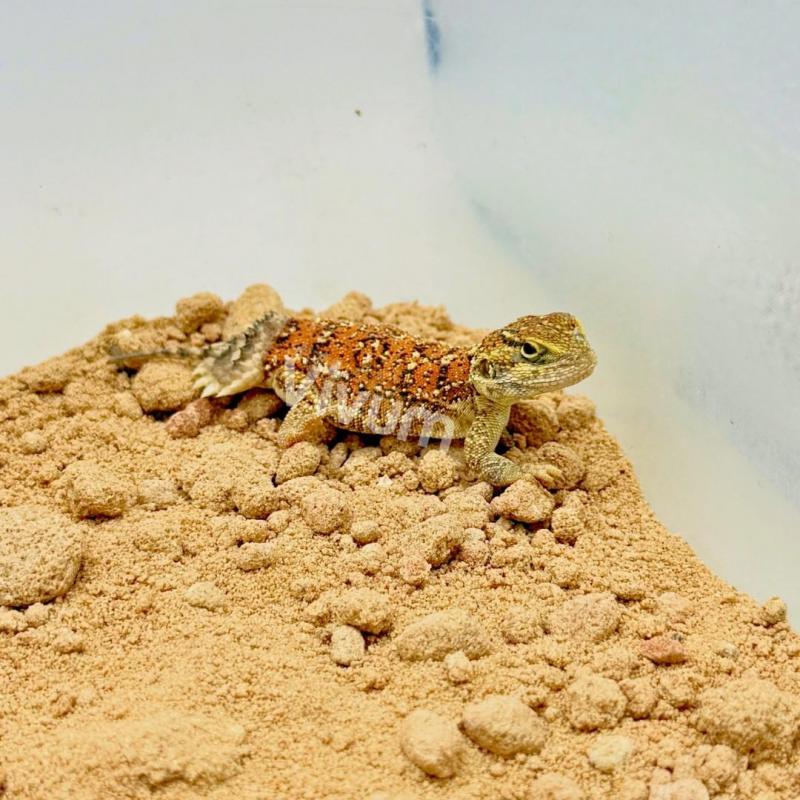
Generic photo of the species
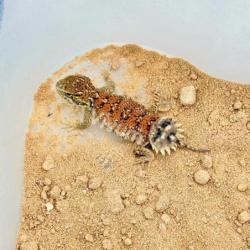
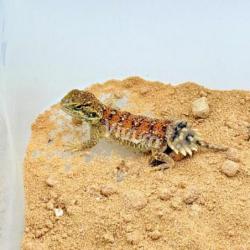
| Common Name: | Shield Tailed Agama |
| Scientific Name: | Xenagama taylori |
| CITES Appendix: | No |
| Annex II Portuguese Ordinance No. 86/2018: | No |
Under Portuguese Law No. 95/2017 of 23 August, the sale and/or advertising of wild/exotic animals through websites or online platforms is not permitted. To find out which animals we currently have available and their conditions of sale, please get in touch with us.
 Progressive Discounts
The more you buy, the less you pay for transport
 Same Day Dispatch
For orders finalized by 3pm
 Live/Frozen Guaranteed Delivery
In live and frozen food
Size: Adults reach around 10cm (including the tail)
Origin: Horn of Africa (eastern Ethiopia, Somalia and Somaliland)
Lifespan: 10 to 15 years in captivity
Natural Habitat: Arid plains and semi-desert areas with sandy or compacted soil, where they dig deep burrows
The Shield Tailed Agama (Xenagama taylori), also known as the Dwarf Shield-tailed Agama or Turnip-tailed Agama, and formerly classified as Agama taylori, is one of the smallest agamas in the world. Its most striking feature is its short, broad tail covered in spiny, shield-like scales, which it uses to block the entrance of its burrow and protect itself from predators.
They are diurnal, very active lizards with plenty of personality, spending their days between long basking sessions and digging their burrows. During the breeding season, adult males display an intense blue throat. Thanks to their small size and fascinating behaviour, they are an excellent choice for anyone looking for a desert lizard to observe in a naturalistic terrarium.
Although this is a relatively easy species to keep, a few aspects require attention and certain conditions must be ensured, as described in the following paragraphs.
Size: Minimum of 60x45x45cm for 1 adult; 90x45x45cm or larger for a pair or trio
Material: Glass or Wood
A terrarium with a pronounced thermal gradient should be provided, with a temperature of around 25ºC on the cool side, between 28ºC and 30ºC on the warm side, and between 42ºC and 45ºC directly beneath the heat lamp/basking spot. These animals tolerate and seek out very high temperatures, so the basking spot should be measured with an infrared thermometer. At night, the temperature can naturally drop to 18-20ºC; only if the room housing the terrarium cools below 16ºC will a Ceramic Heat Emitter or a Deep Heat Projector be needed.
Regarding ultraviolet radiation, it is essential that during the day they are exposed to a UVI between 3 and 7 in the basking area (Ferguson Zone 3-4), while also providing shaded areas where the animal can move away from the radiation. To achieve these UV Index levels, 12 to 14% T5 tubular UV lamps can be used, covering most of the length of the terrarium. A photoperiod of 12 to 14 hours of light is recommended in summer.
In captivity, it is common to simulate a winter cooling period by gradually reducing daylight hours and temperatures for a few weeks. This period is not mandatory for animals not intended for breeding but, if carried out, it should only be done with healthy animals in good body condition, always keeping water available.
Coming from arid regions, they are used to low relative humidity, between 30% and 50%, in a well-ventilated terrarium. However, the burrows they dig maintain a more humid microclimate, which is essential for hydration and healthy shedding. To reproduce this, the lower layers of the substrate should be kept moist while the surface stays dry.
The terrarium can be lightly misted in the morning every 2 or 3 days, creating dew droplets on the walls and decor that many animals use to drink. It is equally essential to always have a shallow water bowl with clean water available in the terrarium.
As a burrowing species, substrate is one of the most important aspects of their care. A layer at least 10 to 15cm deep should be used, made of a substrate that allows stable tunnels to be built, such as a sand and soil mix or a substrate designed for desert terrariums (Arcadia Earth Mix Arid). Adding a small amount of clay (ZooMed Excavator Clay, Exo Terra Stone Desert) helps the burrows keep their shape.
Stones and rocks should be placed directly on the floor of the terrarium, before adding the substrate, to prevent them from collapsing onto the animal when it digs underneath. A flat slab on top of the substrate also makes an excellent basking area. The decor can be complemented with some roots and drought-tolerant plants to create a naturalistic environment. A semi-arid bioactive terrarium is a great option for this species.
They can be kept alone, in pairs or in small groups of one male with two or more females. Two adult males should never be kept in the same terrarium, as they are territorial and can be very aggressive towards each other. Even in compatible groups, it is important to provide several hides and basking spots, as well as plenty of food, and to watch for signs of stress or bites on the flanks and tail, being ready to separate the animals if necessary.
Feeding habits: Omnivorous (mostly insectivorous)
Juvenile Diet: Insects daily, with small portions of greens occasionally
Adult Diet (From 6 months): 80% Insects and 20% Plants, 3 to 4 times a week*
*Make a gradual transition between the juvenile and adult diet. Given their small size, they prefer several small insects over a few large ones.
Insects: Small Crickets, Dubia Roaches (S), Small Locusts, Mealworms, Calcium Worms...
Plants: Dandelion, Kale, Turnip Greens, Watercress, Endive, Rocket, Grated Carrot...
Greens should be offered finely chopped. Toxic foods such as avocado, citrus fruits, mushrooms, onion and rhubarb should be avoided.
For vitamin and mineral supplementation, alternate a meal dusted with Calcium Powder with one dusted with a good-quality Multivitamin Complex (with Vit. D3). It is also advisable to gut-load the insects before offering them, increasing their nutritional value.
Under Portuguese Law No. 95/2017 of 23 August, the sale and/or advertising of wild/exotic animals through websites or online platforms is not permitted. To find out which animals we currently have available and their conditions of sale, please get in touch with us.
