
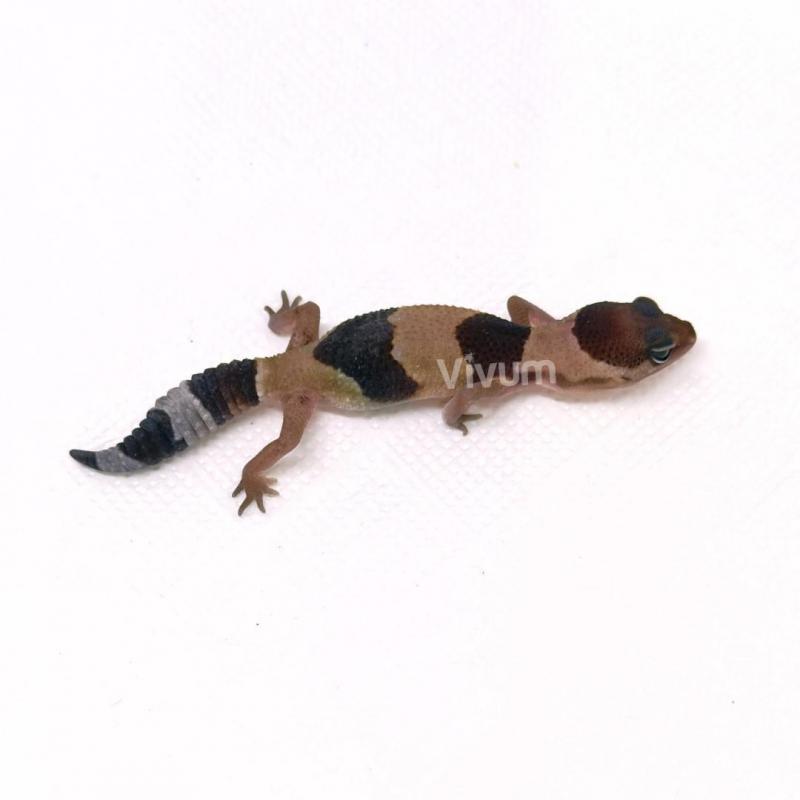
Generic photo of the species
| Common Name: | Gecko Africano de Cauda Gorda |
| Scientific Name: | Hemitheconyx caudicinctus |
| CITES Appendix: | No |
| Annex II Portuguese Ordinance No. 86/2018: | No |
Under Portuguese Law No. 95/2017 of 23 August, the sale and/or advertising of wild/exotic animals through websites or online platforms is not permitted. To find out which animals we currently have available and their conditions of sale, please get in touch with us.
 Progressive Discounts
The more you buy, the less you pay for transport
 Same Day Dispatch
For orders finalized by 3pm
 Live/Frozen Guaranteed Delivery
In live and frozen food
O conteúdo (Texto e Fotografias) desta página está protegido por direitos de autor. A sua cópia, redistribuição ou modificação sem autorização prévia poderá resultar em responsabilização legal.
Size: Adults can reach 22cm
Origin: West Africa
Lifespan: Up to 20 years
Natural Habitat: This species inhabits dry and humid areas of the West African savannah.
The Gecko Africano de Cauda Gorda is an African gecko species of growing popularity. With some similarities to the Gecko Leopardo, both in appearance and ease of care, it is a species suited to beginners and more experienced keepers alike.
Although this is an easy species to keep, a few aspects require attention and certain conditions must be ensured, as described in the following paragraphs.
Size: A minimum terrarium of 60x45x45cm is recommended for 1 adult
Material: Glass
A terrarium with a thermal gradient should be provided, with a minimum temperature of 22ºC on the cool side and a hotspot of up to 32ºC. At night the temperature should not drop below 15ºC. To achieve daytime temperatures, a Halogen or Neodymium heat lamp should be used. At night, the minimum temperature can be maintained with a heat mat if needed. Both daytime and night-time heat sources should be properly controlled by a thermostat.
The Gecko Africano de Cauda Gorda does not require UVB radiation. However, it benefits from exposure to low levels of it (using a ShadeDweller lamp).
This species needs intermediate relative humidity to stay healthy. Ideal humidity is between 50% and 60%. The terrarium should be misted daily, ensuring it dries out after a few hours. It is recommended to always have a hide in the terrarium with higher relative humidity than the rest of the enclosure.
A container of fresh, clean water should always be available.
As this species inhabits both more humid and more arid areas, the terrarium decor should be designed to recreate a mix of both environments. Arcadia EarthMix can be used as substrate, which also makes it possible to create a bioactive terrarium with isopods and springtails. Rocks and branches can be used to create several hiding areas. Plants, natural or artificial, should also be included as extra cover.
Feeding habits: Insectivorous
Diet: Juveniles should be fed every day. As they grow, feeding frequency can be reduced to every other day.
Insects: Crickets, Roaches, Calcium Worms, Waxworms, Mealworms...
For vitamin and mineral supplementation, alternate a meal dusted with Calcium Powder with one dusted with a good-quality Multivitamin Complex (with Vit. D3).
Under Portuguese Law No. 95/2017 of 23 August, the sale and/or advertising of wild/exotic animals through websites or online platforms is not permitted. To find out which animals we currently have available and their conditions of sale, please get in touch with us.
