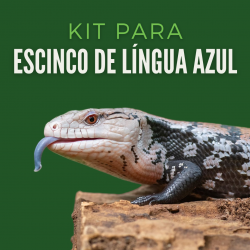
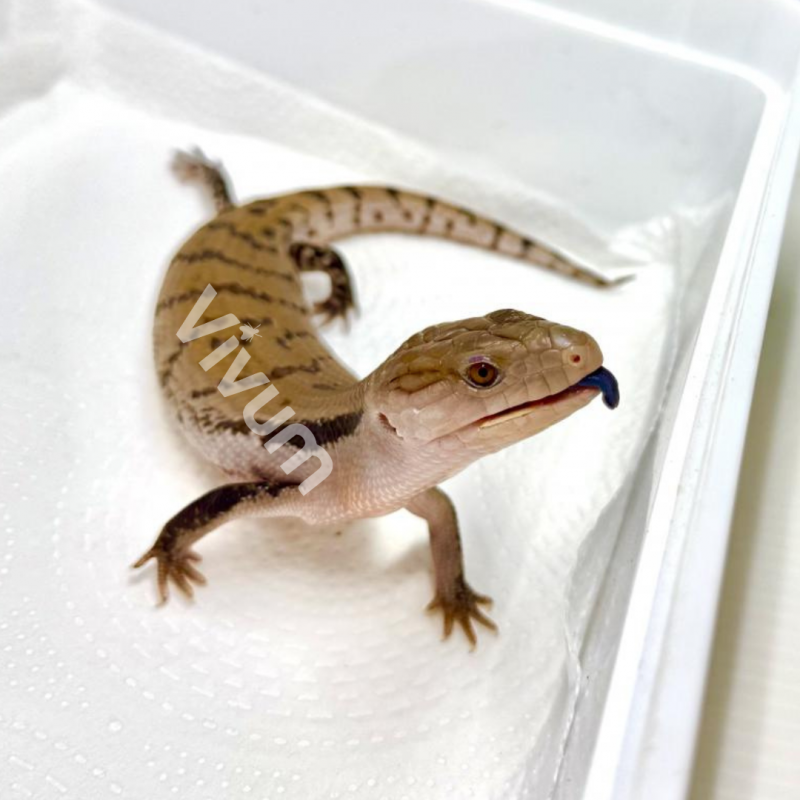
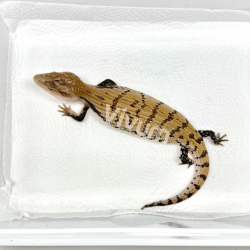
| Common Name: | Escinco de Língua Azul |
| Scientific Name: | Tiliqua gigas evanescens |
| CITES Appendix: | No |
| Annex II Portuguese Ordinance No. 86/2018: | No |
Under Portuguese Law No. 95/2017 of 23 August, the sale and/or advertising of wild/exotic animals through websites or online platforms is not permitted. To find out which animals we currently have available and their conditions of sale, please get in touch with us.
 Progressive Discounts
The more you buy, the less you pay for transport
 Same Day Dispatch
For orders finalized by 3pm
 Live/Frozen Guaranteed Delivery
In live and frozen food
O conteúdo (Texto e Fotografias) desta página está protegido por direitos de autor. A sua cópia, redistribuição ou modificação sem autorização prévia poderá resultar em responsabilização legal.
Size: Adults can reach 60 cm
Origin: Southern New Guinea (Papua New Guinea and Indonesian Papua)
Lifespan: Up to 30 years in captivity
Natural Habitat: The Escinco de Língua Azul is a mainly terrestrial species inhabiting the savannahs and open woodland of southern New Guinea.
Escinco de Língua Azul are one of the most handleable reptile species. Diurnal, they love to dig and explore the substrate. They have a voracious appetite and are an excellent species for interaction. Very docile and easy to keep, they make an excellent animal for beginners and experienced keepers alike.
Although this is an easy species to keep, a few aspects require attention and certain conditions must be ensured, as described in the following paragraphs.
Size: A minimum terrarium of 90x45x45cm is recommended for 1 adult. Juveniles can be kept in proportionally smaller terrariums.
Material: Glass
A terrarium with a thermal gradient should be provided, with a minimum temperature of 22ºC on the cool side, around 26ºC on the warm side and a Basking Spot of around 36ºC. At night the temperature should not drop below 16ºC. To achieve both daytime and night-time temperatures, a heat mat combined with a Basking Spot lamp (properly controlled by a thermostat) can be used.
Being a diurnal species, Escinco de Língua Azul require UVB radiation, which should be provided by 5/6% compact or tubular lamps.
Escinco de Língua Azul are forest animals and therefore need some humidity in their habitat. The terrarium should be misted daily, making sure the substrate is neither dry nor too wet. Relative humidity should be between 60 and 80%.
It is important that the skinks always have access to a water bowl with fresh water.
Escinco de Língua Azul originate from semi-tropical forest areas. A substrate such as Arcadia Earth Mix covered with decorative leaf litter and/or coconut chips should be used. The terrarium can be decorated with caves, stones, branches and cork bark, as well as natural or artificial plants.
Feeding habits: Omnivorous
Diet: An Escinco de Língua Azul's diet should consist of around 45% Meat and Insects, 45% Vegetables and 10% Fruit. Juveniles should be fed every other day. As they grow, feeding frequency can be reduced to 2 to 3 times a week.
Insects: Roaches, Crickets, Calcium Worms, Waxworms, Mealworms...
Meat: Mouse Pinkies, Chicken, Beef.
Vegetables: Collard Greens, Endive, Turnip Greens, Beans, Broad Beans, Squash...
Fruit: Apple, Strawberry, Fig, Mango, Banana, Kiwi, Papaya, Peach...
For vitamin and mineral supplementation, one meal a week should be supplemented with Calcium Powder and another with a good-quality Multivitamin Complex (with Vit. D3).
Under Portuguese Law No. 95/2017 of 23 August, the sale and/or advertising of wild/exotic animals through websites or online platforms is not permitted. To find out which animals we currently have available and their conditions of sale, please get in touch with us.