

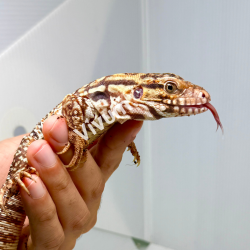
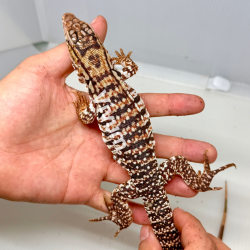
| Common Name: | Tegú Vermelho |
| Scientific Name: | Salvator rufescens |
| CITES Appendix: | Yes, IIB |
| Annex II Portuguese Ordinance No. 86/2018: | No |
Under Portuguese Law No. 95/2017 of 23 August, the sale and/or advertising of wild/exotic animals through websites or online platforms is not permitted. To find out which animals we currently have available and their conditions of sale, please get in touch with us.
 Progressive Discounts
The more you buy, the less you pay for transport
 Same Day Dispatch
For orders finalized by 3pm
 Live/Frozen Guaranteed Delivery
In live and frozen food
Size: Adults can reach 90-140cm (females up to 90cm, males up to 140cm)
Origin: Western Argentina, Bolivia and Paraguay
Lifespan: Up to 20 years (possibly over 30 with exceptional care)
Natural Habitat: Savannahs, dry forests and arid areas of South America, particularly western Argentina
The Tegú Vermelho (Salvator rufescens), formerly known as Tupinambis rufescens, is one of South America's largest terrestrial lizards. It is characterised by its impressive red colouring, which develops with maturity, with males usually more vivid than females. They are extremely intelligent animals, often compared to dogs for their ability to bond with their keepers and respond to clicker training.
This species stands out for its robustness, broad triangular head, prominent jaws (especially in males) and thick, powerful tail. Hatchlings are greenish-brown with black stripes, developing the characteristic reddish tone as they mature, typically between 18 and 24 months of age.
The Tegú Vermelho requires a significant commitment due to its large size, longevity and specific needs. It is only recommended for experienced keepers who can dedicate daily time to socialisation and have adequate space. With proper care, these reptiles can become fascinating, interactive companions.
Size: Minimum of 240x120x90cm for 1 adult (the bigger, the better)
Material: PVC, Wood or Glass (with adequate ventilation)
Important Note: Juveniles can start in 120x60x60cm terrariums but will need regular upgrades as they grow. Never house more than one individual per terrarium. Males must never be housed together, and even females can show territorial aggression.
A terrarium with a strong thermal gradient should be provided. The cool side should be 21-24ºC, while the warm side should reach around 32ºC. The basking spot is crucial for this species and should reach surface temperatures of 45-50ºC. For juveniles under 75cm, the basking spot can be slightly lower (40-45ºC). At night the temperature can drop to 18-20ºC.
To create these high basking temperatures, it is recommended to use several lower-wattage heat lamps rather than a single very powerful one. This creates a wider basking area, reduces the risk of burns and is more energy-efficient. Always use an infrared thermometer to measure surface temperatures accurately.
UVB radiation is absolutely essential for the Tegú Vermelho. This species requires high UVB levels (Ferguson Zone 4), so 10-14% or higher UVB tubes are recommended. Lamps should be replaced every 6-12 months even if they still emit visible light, as UVB output decreases over time. The photoperiod should simulate the seasons: 12-14 hours of light during active months and 8-10 hours during brumation.
Tegú Vermelho require humidity levels between 60% and 80%. These can be maintained by regular misting (1-2 times a day), moisture-retaining substrates and a large water container in which the animal can fully submerge to hydrate and thermoregulate.
It is essential to always provide a container of clean, fresh water large enough for the tegu to submerge completely. The water should be changed daily, as these animals often defecate in it. During shedding (ecdysis), slightly increasing humidity can help the process.
Substrate is one of the most important aspects of the Tegú Vermelho's terrarium. This species loves to dig and spend time in burrows, so a deep layer of substrate is essential – ideally 30-40cm deep, at least in one section of the terrarium. Suitable substrates include mixes of coco fibre, peat, sphagnum moss and fertiliser-free soil. The substrate should be kept slightly moist but never waterlogged.
Decor should include sturdy, stable elements, as tegus are strong, heavy animals. Securely stacked rocks (ideally glued), thick logs, cork bark and branches can create an enriched three-dimensional environment. Although mainly terrestrial, they enjoy climbing occasionally. Provide at least one large, sturdy hide, preferably in a cooler area of the terrarium.
Hardy artificial or natural plants can be added, but bear in mind they may be trampled or destroyed. If using live plants, choose robust, non-toxic species.
Brumation (hibernation) is a natural behaviour of Tegú Vermelho during the winter months. During this period, which can last 3-6 months, the animals drastically reduce their activity, stop eating and stay in their burrows most of the time, with a metabolic reduction of around 80%.
In captivity, brumation is not mandatory for the animal's health, but it is essential if you intend to breed the species, especially for females. Many keepers choose to allow it as they believe it offers long-term health benefits and replicates important natural behaviours.
If you choose to allow brumation, prepare the animal gradually by reducing light hours, slightly lowering temperatures and cutting back food over the preceding 2-3 weeks. During brumation, keep temperatures lower (15-20ºC), minimise disturbance and offer fresh water weekly, although the animal will rarely drink. Emergence from brumation should be gradual, progressively increasing light and temperature.
Feeding habits: Opportunistic omnivore
Juvenile Diet (0-2 years): 70-80% Animal Protein and 20-30% Fruit and Vegetables
Adult Diet (over 2 years): 60% Animal Protein and 40% Fruit and Vegetables
Juveniles should be fed daily due to their rapid growth. Adults can be fed 3-5 times a week, avoiding obesity through portion control. Varying the diet is essential to ensure a complete nutritional profile.
Animal Protein: Crickets, Roaches (Dubia, Red Runner), Locusts, Mealworms, Zophobas, Waxworms (occasionally, high in fat), Mice and Rats (pre-killed, in moderation), Cooked eggs, Unseasoned cooked chicken or turkey, Boneless fish
Fruit: Mango, Papaya, Fig, Banana, Melon, Strawberries, Raspberries, Blueberries, Apple (seedless), Pear (seedless)
Vegetables and Leafy Greens: Squash, Courgette, Bell Pepper, Cabbage, Turnip Greens, Watercress, Dandelion, Chicory, Grated Carrot
Foods to Avoid: Never offer processed foods, raw pork, excessive citrus fruit or wild-caught insects that may have been exposed to pesticides. Avoid rodents as a staple for adults due to their high fat content.
Proper supplementation is critical to prevent metabolic bone disease and nutritional deficiencies. For growing juveniles, dust insects with calcium powder (without D3) at every meal. Once a week, use a calcium supplement with D3 and a good-quality reptile-specific multivitamin.
For adults, frequency can be reduced to 3-4 times a week with calcium without D3, and weekly with calcium with D3 and a multivitamin. If the tegu has regular access to quality UVB and natural sunlight, the need for D3 supplementation can be slightly reduced but never eliminated entirely.
Under Portuguese Law No. 95/2017 of 23 August, the sale and/or advertising of wild/exotic animals through websites or online platforms is not permitted. To find out which animals we currently have available and their conditions of sale, please get in touch with us.
