| Common Name: | Tartaruga Hermanni |
| Scientific Name: | Testudo hermanni |
| CITES Appendix: | Yes, IIA |
| Annex II Portuguese Ordinance No. 86/2018: | No |
Under Portuguese Law No. 95/2017 of 23 August, the sale and/or advertising of wild/exotic animals through websites or online platforms is not permitted. To find out which animals we currently have available and their conditions of sale, please get in touch with us.
 Progressive Discounts
The more you buy, the less you pay for transport
Progressive Discounts
The more you buy, the less you pay for transport
 Same Day Dispatch
For orders finalized by 3pm
Same Day Dispatch
For orders finalized by 3pm
 Live/Frozen Guaranteed Delivery
In live and frozen food
Live/Frozen Guaranteed Delivery
In live and frozen food
Size: As adults, the western subspecies (T. h. hermanni) reaches 13-18cm, while the eastern subspecies (T. h. boettgeri) can reach 20-28cm
Origin: Southern Europe (Spain, France, Italy, Greece, the Balkans, Turkey and Mediterranean islands)
Lifespan: 70 to over 100 years
Natural Habitat: They inhabit Mediterranean scrubland, rocky slopes and open meadows of southern Europe
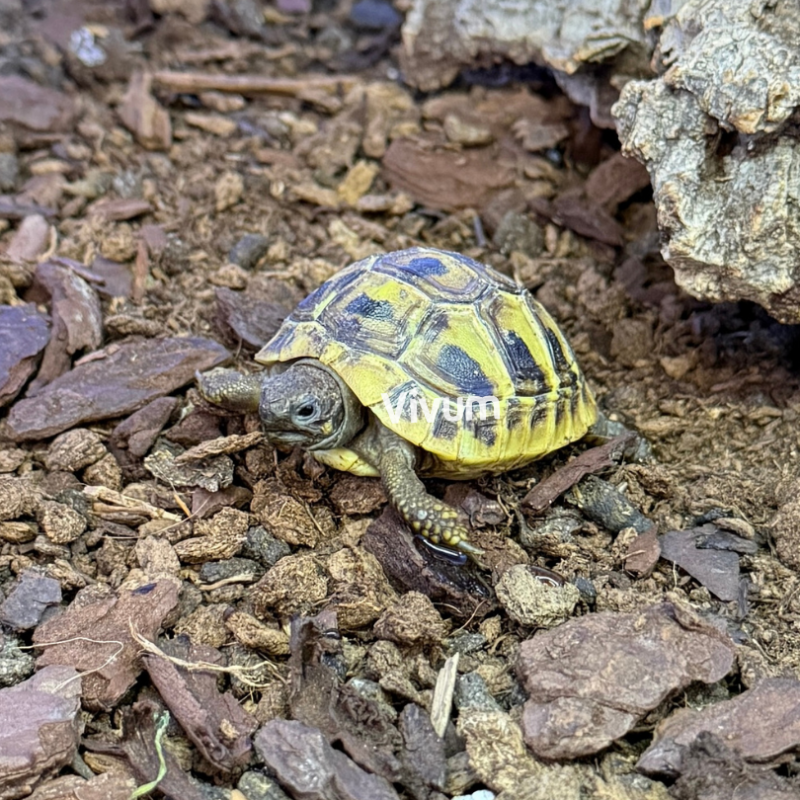
The Tartaruga Hermanni (Testudo hermanni) is one of Europe's most popular and iconic tortoise species, and one of the most valued in the pet reptile world. Its calm, curious temperament, together with its distinctive look — a domed shell with a contrasting yellow and black pattern — makes it a fascinating companion. There are two recognised subspecies: the western Tartaruga Hermanni (T. h. hermanni), smaller and more brightly coloured, and the eastern Tartaruga Hermanni (T. h. boettgeri), larger with a darker shell. Both have similar care requirements.
It is a long-lived species with specific needs — particularly regarding space, sun exposure and diet — so commitment to its wellbeing must be long term. With proper care, you can share decades with this animal.
Size: For juveniles, a minimum indoor enclosure of 100x50cm is recommended; for adults, an outdoor enclosure is highly preferable, at least 2x1m. In Portugal, the climate allows adults to be kept outdoors for much of the year.
Material: Outdoor enclosure with solid walls, escape-proof and predator-proof; for juveniles, a wooden tortoise table or ventilated glass enclosure indoors
Set up an enclosure with a thermal gradient, with an ambient zone of 24ºC to 28ºC during the day and a basking spot reaching 32-35ºC. At night the temperature can drop to 18-20ºC. For animals kept indoors, use a heat lamp over a flat stone to create the basking spot.
UVB is absolutely essential for the health of the Tartaruga Hermanni, being indispensable for vitamin D3 synthesis and proper calcium metabolism. For animals kept indoors, 10-12% T5 UVB tubes (Ferguson Zone 3-4) replaced every 6-12 months are recommended. Animals kept outdoors benefit directly from natural sunlight, the best UVB source available — one of the great advantages of the Portuguese climate for keeping this species.
The Tartaruga Hermanni comes from Mediterranean habitats with a dry to semi-humid climate. The ideal relative humidity for adults is between 40% and 60%, and there should always be a more humid area (for example, a hide with damp sphagnum moss) where the animal can shelter and hydrate. For juveniles, it is important to keep humidity higher — between 60% and 70% — to ensure healthy shell growth and prevent dehydration.
A shallow container of fresh water should always be available, low enough for the tortoise to get in and out easily. Regular 10-15 minute baths in lukewarm water (2 to 3 times a week for juveniles, weekly for adults) are highly recommended to promote hydration and stimulate defecation.
The enclosure should mimic this species' natural Mediterranean environment. The ideal substrate is a mix of fertiliser-free topsoil, sand and coco fibre at least 10-15cm deep to allow natural digging. For juveniles indoors, you can also use slightly dampened coco fibre or a soil-and-sand mix.
Decor should include flat stones (ideal for thermoregulation under the basking spot), logs and hides. It is important to provide shelters where the tortoise can escape the heat or sleep. Safe, edible plants — such as clover, dandelion or mallow — can be sown in the outdoor enclosure, serving as both enrichment and food. In outdoor enclosures, make sure no toxic plants are within the animal's reach.
Feeding habits: Strict herbivore
Diet: The Tartaruga Hermanni's diet should be entirely plant-based, high in fibre and low in protein and sugar. In captivity it should be managed as a strict herbivore. The diet should be based on wild weeds and plants (70-80%), complemented by leafy greens (20-30%) and fruit only occasionally (less than 5%). Juveniles should be fed daily; adults can be fed 4 to 5 times a week.
Wild weeds and flowers (staple diet): Dandelion (leaves and flowers), plantain, clover, thistle, wild chicory, mallow, herb Robert, sorrel (in moderation)
Leafy greens: Chicory, radicchio, endive, escarole, rocket, watercress, turnip greens, cabbage (in moderation), purslane
Other vegetables (in moderation): Pumpkin, courgette, pepper, carrot (grated)
Edible flowers: Hibiscus, mallow, dandelion, rose (free of chemical treatments), violet
Fruit (rarely and in very small amounts): Fig, strawberries, raspberries, melon
Note: Avoid foods high in oxalates (such as spinach and beetroot), animal protein or sugar. Fruit and calorie-dense vegetables should be treated as occasional treats, not as the basis of the diet.
Correct supplementation is essential to prevent metabolic bone disease. Use a Calcium supplement (without vitamin D3, as animals with adequate UVB access make their own D3) at every meal, lightly dusting the food. A quality Multivitamin Complex (with vitamin D3) should be offered once a week. For animals kept exclusively indoors with less natural UVB, a Calcium supplement with D3 may be needed. A cuttlefish bone permanently available in the enclosure is also an excellent way for the animals to self-supplement calcium and keep their beak healthy.
Under Portuguese Law No. 95/2017 of 23 August, the sale and/or advertising of wild/exotic animals through websites or online platforms is not permitted. To find out which animals we currently have available and their conditions of sale, please get in touch with us.