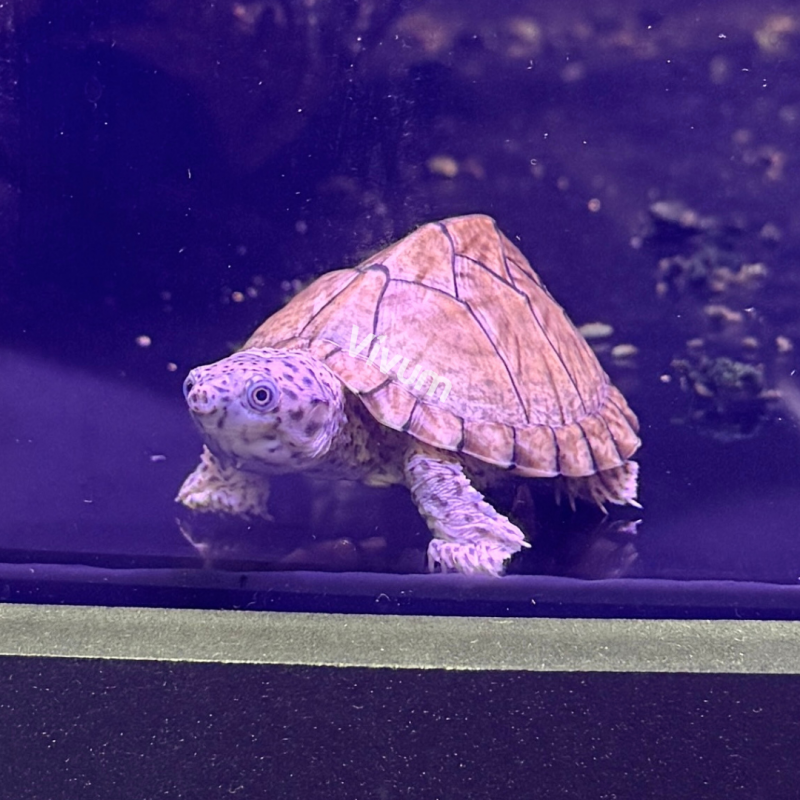
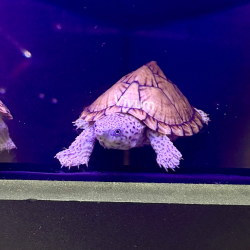
| Common Name: | Tartaruga Almiscarada |
| Scientific Name: | Sternotherus carinatus |
| CITES Appendix: | Yes, IIB |
| Annex II Portuguese Ordinance No. 86/2018: | No |
Under Portuguese Law No. 95/2017 of 23 August, the sale and/or advertising of wild/exotic animals through websites or online platforms is not permitted. To find out which animals we currently have available and their conditions of sale, please get in touch with us.
 Progressive Discounts
The more you buy, the less you pay for transport
 Same Day Dispatch
For orders finalized by 3pm
 Live/Frozen Guaranteed Delivery
In live and frozen food
O conteúdo (Texto e Fotografias) desta página está protegido por direitos de autor. A sua cópia, redistribuição ou modificação sem autorização prévia poderá resultar em responsabilização legal.
Size: Adults usually reach a shell length of 8–12 cm, rarely exceeding 13 cm
Origin: Eastern North America (south-eastern Canada and eastern USA)
Lifespan: Up to 40 years
Natural Habitat: They inhabit calm, small to medium-sized watercourses, lakes and swamps with muddy bottoms and abundant vegetation.
Other names: Common Musk Turtle, Stinkpot; Kinosternon odoratum (synonym)
The Tartaruga Almiscarada is an aquatic turtle species that is uncommon in the hobby. However, its relatively small size, hardiness and ease of care make it a very attractive pet turtle for many enthusiasts. Its name comes from the strong-smelling secretion (musk) it releases when it feels threatened.
Although this is a relatively easy species to keep, a few aspects require attention and certain conditions must be ensured, as described in the following paragraphs.
Size: Minimum of 60x45x25 cm (about 65 litres) for 1 adult
Material: Glass
Although mainly aquatic, Tartaruga Almiscarada also like to venture onto land occasionally to bask. A basking area of 28-32 °C should be provided. A 5-7% UVB lamp should also be used to provide the appropriate levels of ultraviolet radiation for this aquatic turtle species.
The water temperature should be kept at 23-26 °C with a submersible aquarium heater, preferably protected by a guard or cover to prevent burns and damage to the heater.
A filter is needed to keep the water clean, as these animals produce a lot of waste. Use a filter rated for 2 to 3 times the aquarium’s water volume, with a low or adjustable flow.
Use fine sand or leave the bottom bare. Avoid gravel and small stones, which can be swallowed and cause intestinal blockages. The aquarium can be decorated with rocks larger than the animal’s head, wood and live/artificial plants.
Although they spend most of their time walking along the bottom, Tartaruga Almiscarada are not strong swimmers: they must have wood, rocks or plants that let them easily reach the surface to breathe, otherwise there is a risk of drowning.
Feeding habits: Omnivorous (mainly carnivorous)
Diet: Juveniles should be fed daily; adults 3 to 4 times a week.
Staple: The staple diet should be a commercial food formulated specifically for aquatic turtles.
Occasional: Crickets, Roaches, Locusts, Mealworms, Calcium Worms, Bloodworms, snails, shrimp, small fish (avoid goldfish, which are rich in thiaminase), Waxworms (rarely)...
Good-quality commercial foods are already supplemented. Even so, a cuttlebone should be kept in the water at all times as an extra source of calcium.
Under Portuguese Law No. 95/2017 of 23 August, the sale and/or advertising of wild/exotic animals through websites or online platforms is not permitted. To find out which animals we currently have available and their conditions of sale, please get in touch with us.