
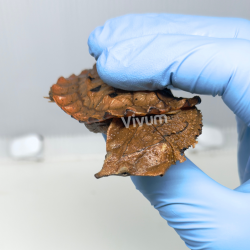
| Common Name: | Tartaruga Mata-Mata |
| Scientific Name: | Chelus fimbriata |
| CITES Appendix: | Yes, IIB |
| Annex II Portuguese Ordinance No. 86/2018: | No |
Under Portuguese Law No. 95/2017 of 23 August, the sale and/or advertising of wild/exotic animals through websites or online platforms is not permitted. To find out which animals we currently have available and their conditions of sale, please get in touch with us.
 Progressive Discounts
The more you buy, the less you pay for transport
Progressive Discounts
The more you buy, the less you pay for transport
 Same Day Dispatch
For orders finalized by 3pm
Same Day Dispatch
For orders finalized by 3pm
 Live/Frozen Guaranteed Delivery
In live and frozen food
Live/Frozen Guaranteed Delivery
In live and frozen food
Size: Adults can reach 45cm
Origin: South America — Amazon Basin (Brazil, Peru, Venezuela, Colombia, Ecuador, Bolivia and the Guianas)
Lifespan: Up to 40 years in captivity
Natural Habitat: They inhabit calm, shallow, dark (blackwater) rivers, swamps, pools and streams of the Amazon Basin
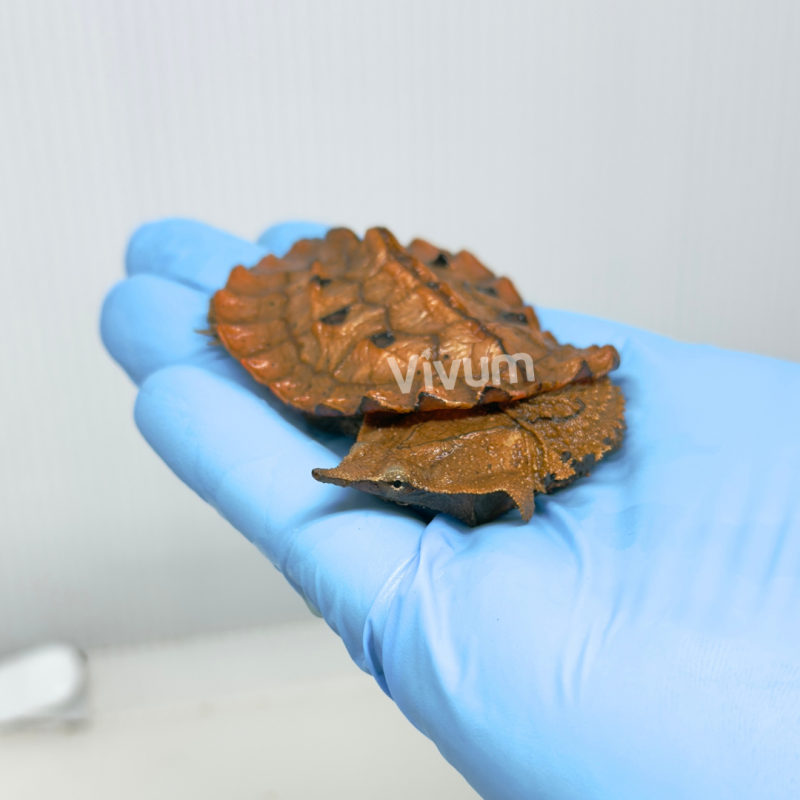
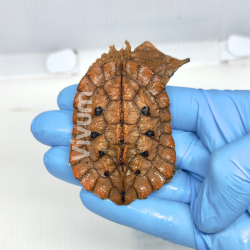
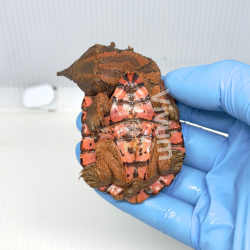
The Tartaruga Mata-Mata (Chelus fimbriata) is one of the most extraordinary and peculiar turtles on the planet. Its flattened silhouette, rough shell and the many skin flaps covering its head and neck give it perfect camouflage among leaves and debris on the bottom of the Amazon's black waters. It is a highly specialised ambush predator: instead of chasing prey, it stays motionless and, with a sudden movement, expands its throat to create a suction current that swallows the fish whole in an instant.
It is an exclusively aquatic species — it rarely leaves the water — and does not need a land basking area, unlike most aquatic turtles. Its water quality requirements are very specific, calling for conditions that replicate the acidic, tannin-rich waters of the Amazon. For these reasons, the Tartaruga Mata-Mata is considered a species for experienced keepers who understand the particulars of its care.
Size: Minimum 150x60cm base area for 1 adult (in the long term, a larger indoor tank or pond is recommended)
Material: Glass or resin (aquarium or indoor pond)
The Tartaruga Mata-Mata is a strictly aquatic species and does not leave the water to bask. Heating is provided solely through the water temperature, which should be kept between 25ºC and 28ºC all year round, using a properly sized aquarium heater monitored with an accurate aquarium thermometer. It is also important to keep the room air close to this temperature range, so the turtle does not breathe cold air when it surfaces — which can cause respiratory infections.
Although it does not need to bask, the Tartaruga Mata-Mata benefits from low to moderate UVB exposure, as wild animals receive the light that penetrates the water column. A UVB tube is recommended (6% if installed 30–40cm above the water surface; 12% if installed at 40–60cm), on a 12-hour photoperiod.
Water quality is the most critical factor for the health of the Tartaruga Mata-Mata in captivity. This species requires acidic water, with a pH between 5.0 and 5.5, enriched with tannins to simulate the Amazon's black waters. This can be achieved by adding dried oak or catappa leaves, peat, and wooden roots and logs (e.g. mangrove root or bogwood) directly to the aquarium. The water may turn brownish, which is completely normal and desirable.
Filtration is essential to keep ammonia and nitrate levels low, but it must be gentle — the Mata-Mata prefers water with little current. Use an external filter with adjustable flow and make sure the outlet does not create excessive turbulence; placing roots or rocks in the return area helps disperse the flow. Partial water changes (20–30%) should be carried out weekly.
The water should be deep enough for the turtle to submerge completely, but not so deep that it has to swim to breathe. Ideally it can simply stretch its neck and reach the surface with its "snorkel" while staying on the bottom — usually a depth between 20 and 40cm is suitable, adjusted to the size of the animal. The substrate should be fine, smooth sand without abrasive particles, so as not to damage the plastron and delicate skin flaps.
Recreate the Amazon habitat with wooden roots and logs (bogwood, mangrove root), dried oak or catappa leaves on the bottom and warm-water aquatic plants. The Tartaruga Mata-Mata is a cryptic species that benefits from plenty of cover and hides on the bottom of the aquarium. Avoid decor with sharp edges that could damage its skin flaps. No land area is needed, although a small platform near the surface can be offered.
Feeding habits: Strict carnivore — ambush predator specialised in live fish
Diet: The Tartaruga Mata-Mata feeds almost exclusively on live fish, which it swallows whole by suction. Most individuals refuse dead prey, especially during the initial adaptation period. It can be fed 2 to 3 times a week, offering an amount of fish proportional to the turtle's size. With patience, some individuals can learn to accept dead fish or other meaty foods presented with simulated movement.
Live fish: Guppies, platies, mollies, mosquitofish, minnows, feeder goldfish — always offer a variety of species to ensure a more complete nutritional profile.
Aquatic invertebrates: Earthworms, freshwater shrimp, mussels — can be offered as a supplement to enrich the diet.
Supplementation is a challenge with this species, given its aquatic environment and preference for live prey. Fish swallowed whole provide calcium through their bones, a natural source of this mineral. For individuals that accept dead fish, liquid supplements can be injected directly into the prey before offering it.
Under Portuguese Law No. 95/2017 of 23 August, the sale and/or advertising of wild/exotic animals through websites or online platforms is not permitted. To find out which animals we currently have available and their conditions of sale, please get in touch with us.
